
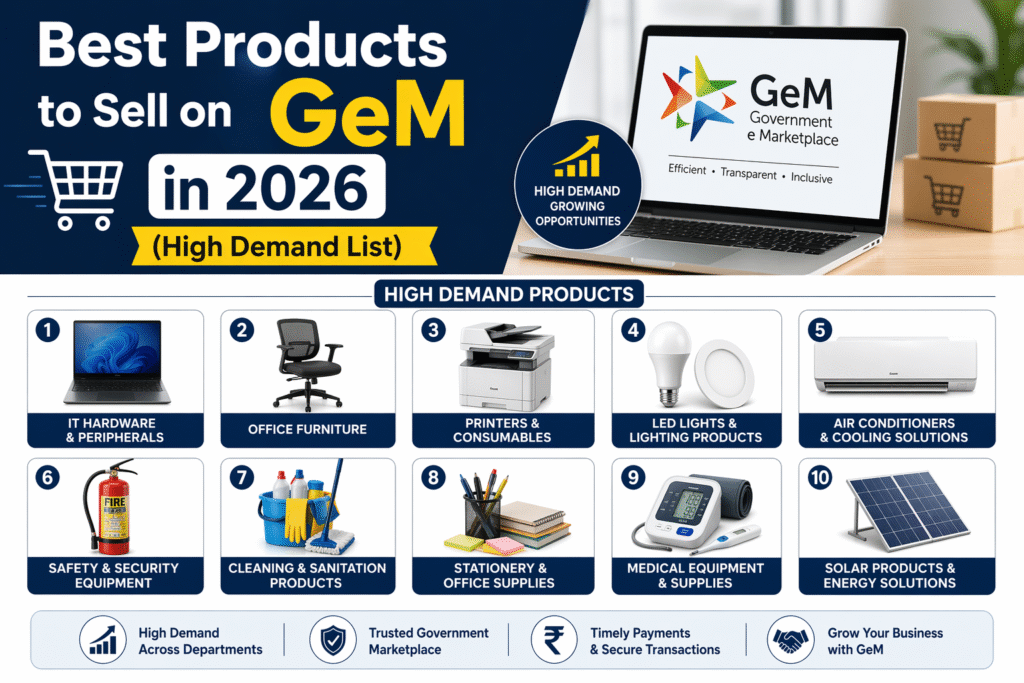
The Government e-Marketplace (GeM) has crossed a cumulative GMV of ₹18.4 lakh crore, and in FY 2025-26 alone it surpassed ₹5 lakh crore in procurement — making it one of the world’s most active public procurement platforms. For sellers, this is not just an opportunity. It is one of the most stable and recession-proof sales channels available in India today.
If you are planning to register on GeM or want to know which products are moving the fastest in 2026, this guide will save you hours of research. We have compiled the highest-demand product categories, explained what makes each one consistently profitable, and answered the most common questions sellers ask before getting started.
Why GeM in 2026 Is a Seller’s Best Bet?
Government procurement in India has shifted decisively online. Over 1.6 lakh government buyer organisations now source everything from furniture to solar panels exclusively through GeM. Policy reforms in 2024-25 — including reduced transaction charges, lower vendor assessment fees, and easier caution money requirements — have made the platform far more accessible to MSMEs and first-time sellers.
The platform now hosts more than 10,900 product categories and 330 service categories. But not all categories perform equally. The sellers who consistently win orders are those who list products in categories that see repeat, high-volume government demand. Below is the definitive breakdown for 2026.
Top High-Demand Products to Sell on GeM in 2026
1. IT Hardware and Electronics
Desktops, laptops, tablets, networking equipment, projectors, and rugged devices consistently rank among the top-ordered products on GeM. India’s accelerated digitization push across ministries, educational institutions, and PSUs drives year-round demand in this category. Government departments upgrade their hardware on fixed procurement cycles, which means predictable, large-ticket orders for registered sellers. Brands that comply with Make in India criteria and carry BIS certification are given procurement preference, making this a strong entry point for Indian manufacturers and authorized distributors.
2. Office Furniture and Modular Workstations
Furniture remains one of the most consistently ordered product categories on GeM. Government offices, police stations, district courts, and educational institutions are in a near-permanent cycle of renovation and expansion. Ergonomic chairs, executive desks, steel almirahs, conference tables, and modular storage units all see regular demand. Sellers who offer green-certified or BIS-compliant products tend to win tenders more frequently, as government procurement guidelines increasingly factor in sustainability standards.
3. Medical Supplies and Healthcare Equipment
Post-pandemic procurement norms have permanently elevated the baseline demand for medical supplies across government health departments and hospitals. PPE kits, diagnostic equipment, ICU monitors, surgical instruments, and cold chain systems are among the fastest-growing sub-categories. The Government of India actively encourages quality-certified medical equipment suppliers on GeM, and this category benefits from both central and state-level procurement budgets running simultaneously throughout the year.
4. Solar Panels and Electrical Equipment
India’s infrastructure boom is creating sustained demand for UPS systems, transformers, solar panels, LED lighting, and HVAC systems on GeM. The government’s renewable energy targets under the National Solar Mission mean that solar-related products are now among the highest-order-value categories on the portal. Sellers registered under approved vendor lists for MNRE and state electricity boards find GeM to be a direct route to large-volume contracts.
5. Electric Vehicles and Auto Components
With the government mandating EV adoption for official fleet replacement, electric cars, two-wheelers for field workers, and utility vehicles have emerged as a high-value category. Auto spare parts and maintenance components for existing government fleets also see consistent procurement. This is one of the fastest-growing GeM categories by order value in 2025-26, and early registered sellers enjoy a significant first-mover advantage due to low competition.
6. Stationery and Office Consumables
Despite widespread digitization, the government’s appetite for stationery remains strong. Printed forms, A4 paper, pens, envelopes, files, and exam stationery are ordered in bulk quantities throughout the year. This category is ideal for small and micro sellers because the investment threshold is low, compliance requirements are straightforward, and orders repeat on monthly or quarterly cycles. It is one of the most accessible entry points for new GeM sellers in 2026.
7. Uniforms, Workwear, and Safety Gear
Uniforms for police, defence auxiliaries, municipal workers, and school children under government schemes represent a large and reliable procurement category. Industrial safety equipment — helmets, gloves, reflective vests, and safety footwear — is also ordered consistently by public works departments and construction agencies. Sellers with in-house manufacturing or direct tie-ups with BIS-certified factories are best positioned in this segment.
8. Cleaning Supplies and Housekeeping Products
Facility management has grown into one of the fastest-moving product categories on GeM. Floor cleaners, disinfectants, brooms, mops, and sanitation supplies are ordered in volume by hospitals, railway stations, airports, and government offices. The Swachh Bharat compliance mandate across public institutions has made hygiene products a recurring, high-frequency procurement category with steady reorder cycles.
Quick Reference: GeM Product Demand Matrix 2026
| Product Category | Demand Level | Avg. Order Value | Competition | Best For |
|---|---|---|---|---|
| IT Hardware & Laptops | Very High | ₹50K – ₹25L | High | Distributors, Manufacturers |
| Office Furniture | Very High | ₹20K – ₹10L | Medium | Manufacturers, Traders |
| Medical Supplies | High | ₹10K – ₹50L | Medium | Certified Suppliers |
| Solar & Electrical | High | ₹1L – ₹1Cr+ | Medium | MNRE-listed Vendors |
| Electric Vehicles | High (Rising) | ₹5L – ₹40L | Low | OEMs, Dealers |
| Stationery & Supplies | Steady | ₹2K – ₹2L | High | MSMEs, New Sellers |
| Uniforms & Workwear | Steady | ₹50K – ₹20L | Medium | Garment Manufacturers |
| Cleaning & Sanitation | Steady (Rising) | ₹5K – ₹5L | Medium | All Seller Types |
What Makes a Product Win on GeM?
Listing a product is only half the work. Government buyers evaluate catalogues based on price competitiveness, compliance certifications, delivery timelines, and seller ratings. A few factors separate sellers who win repeat orders from those who stagnate at the listing stage.
Certification matters more than price. Products with BIS certification, ISI mark, or specific ministry approvals are shortlisted faster in GeM’s automated bid filtering. If your product category requires a certification, obtaining it before listing is non-negotiable. Buyers consistently prefer sellers who include complete technical documentation in their product catalogues.
Catalogue quality drives visibility. GeM’s internal search algorithm ranks product listings based on description completeness, number of images, and catalogue compliance score. A well-structured catalogue with accurate specifications, correct HSN code alignment, and at least three compliant product images consistently outranks incomplete listings — regardless of price.
Delivery performance compounds over time. GeM assigns a seller rating that is visible to all buyers. Sellers who maintain above a 4-star rating and a high on-time delivery percentage receive preferential placement in search results. Early discipline in fulfillment creates a compounding advantage that is very difficult for newer sellers to overcome.
Seller Registration: What You Need in 2026
Registration on GeM requires a valid Udyam registration or company PAN, a bank account linked to your business entity, and GST registration. For certain product categories — particularly electronics, medical equipment, and defence-linked items — an additional Vendor Assessment may be required, though the fee for this was significantly reduced in the 2024-25 policy reforms.
Once registered, sellers list products through the Catalogue Management System by selecting the correct category, filling technical specifications, uploading images, and setting offer pricing relative to MRP. Products go live after a compliance check, which typically takes 24 to 72 hours for standard categories.
Frequently Asked Questions
Q. Is GeM only for manufacturers, or can traders also register?
Both manufacturers and traders can register on GeM. Traders need to upload their trade license and GST certificate during registration. However, for certain high-value tenders, manufacturers may receive a price preference under the Make in India policy, so traders should factor this into their pricing strategy from the start.
Q. What is the minimum turnover required to sell on GeM?
There is no minimum turnover requirement for MSMEs and startups to list on GeM. Large enterprises may need to meet specific financial criteria for high-value bids, but for most product categories, any GST-registered business can begin selling without a turnover threshold.
Q. How are payments processed on GeM? Are they reliable?
GeM follows a structured payment process where government buyers are required to release payment within a defined number of days after delivery confirmation. MSEs receive statutory payment protection, and GeM’s integrated payment gateway reduces delays considerably. Payment reliability has improved significantly in 2025-26, with the portal having processed over 2.86 crore orders cumulatively.
Q. What certifications do I need to sell electronics or IT hardware on GeM?
BIS registration under the CRS scheme is mandatory for most electronics including laptops, monitors, and networking devices. Additionally, many government buyers prefer or mandate compliance with the Phased Manufacturing Programme (PMP) for items like mobile phones and tablets. Always verify category-specific requirements on the GeM portal before listing.
Q. Can I sell in multiple categories simultaneously on GeM?
Yes. A single GeM seller account can list products across multiple categories, provided the products and their certifications align with the requirements of each category. Managing a diversified catalogue is a common strategy among high-performing GeM sellers and there is no restriction on the number of categories.
Q. How competitive is pricing on GeM? Can I maintain healthy margins?
GeM uses a price comparison mechanism that shows buyers the lowest available price for a product. However, price is not the only selection criterion — delivery speed, seller rating, compliance, and catalogue quality all influence buyer decisions. Sellers who build a strong reputation are able to maintain healthy margins without always needing to be the lowest-priced option, particularly in low-competition categories like EVs and solar equipment.
Q. How long does it take to get the first order after listing on GeM?
For high-demand categories like stationery, office furniture, and cleaning supplies, first orders can arrive within 15 to 30 days of a compliant listing going live. For specialized categories like medical equipment or solar panels, the timeline may be longer depending on active tenders. Sellers who actively participate in reverse auctions on the GeM bid section tend to generate orders faster than those who rely solely on direct purchase.
The Bottom Line
GeM in 2026 is not a side opportunity — it is a primary revenue channel for thousands of Indian businesses. The platform’s scale, payment reliability, and policy support make it one of the most accessible government marketplaces in the world. The sellers who will dominate the next three years are those who list in the right categories, maintain catalogue quality, and treat government procurement with the same discipline they apply to any high-value B2B relationship. Start with one category, get your certifications in order, and build your rating from day one.
For more guides on GeM registration, catalogue management, and bid strategy — follow BizWithTech.
Discover more from
Subscribe to get the latest posts sent to your email.