
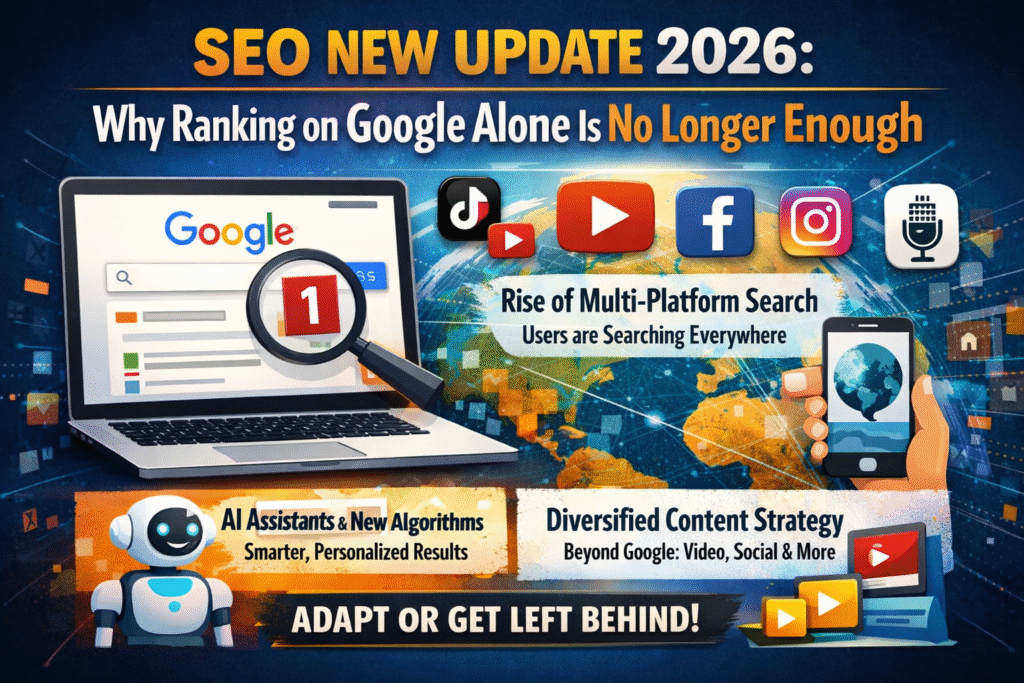
In 2026, getting your website to rank on Google is still important. But here is the hard truth — it is no longer enough on its own. The way people search for information has changed dramatically, and the rules of visibility have shifted beneath our feet.
Search is no longer a single destination. It is a network of AI-powered platforms, each answering questions in their own way, from their own sources. If your brand only shows up on Google’s traditional blue links, you are already losing ground to competitors who have embraced a broader strategy.
What Has Actually Changed in 2026
Google has always updated its algorithm. But what happened between 2024 and 2026 is different in nature, not just in degree.
AI Overviews, Google’s AI Mode, ChatGPT Search, Perplexity, and Gemini have fundamentally changed how users interact with search. Instead of clicking ten blue links and choosing for themselves, users now receive a synthesized answer at the top of the page, assembled from multiple sources. Your page may rank in position one and still never be seen by the user.
The search bar is no longer a retrieval tool. It is a reasoning engine. And reasoning engines play by different rules.
The Three Layers of Visibility You Now Need
Traditional SEO gave you one metric to care about: your position in the search results. In 2026, there are three distinct layers of visibility that every brand must compete for simultaneously.
The first is your classic Google SERP ranking, which still matters for high-intent, transactional searches. The second is inclusion in AI-generated answer summaries, where platforms like Google AI Overviews and Perplexity cite your content directly within their generated responses. The third is brand mention and citation across LLMs, meaning that when someone asks ChatGPT or Claude a question in your industry, your brand name comes up as a trusted reference.
Focusing only on the first layer means you are optimizing for a shrinking share of total search traffic.
Key Numbers That Redefine the Game in 2026
| Metric | Data Point | Source |
|---|---|---|
| URLs cited by AI Mode that rank in top 10 | Only 14% | SE Ranking, 2025 |
| Pages updated within 6 months cited by AI | 2.5x more often | Wellows, 2026 |
| Sites with 32K+ referring domains cited by ChatGPT | 3.5x more likely | SE Ranking, 2025 |
| Domains on review platforms cited by ChatGPT | 3x higher chance | SE Ranking, 2025 |
| Total search usage growth (search engines + LLMs combined) | Up 26% globally | Graphite, March 2026 |
How LLMs Read Your Content Differently from Google
Google’s traditional crawler indexes your page and ranks it based on keywords, backlinks, and technical signals. An LLM does something entirely different. It interprets your content, extracts facts, evaluates the credibility of your claims, and decides whether you are a source worth referencing when generating an answer.
This distinction is foundational to understanding why your current SEO strategy may be falling short.
LLMs do not care how many times you used a keyword. They care whether your content is structured, factually sound, semantically complete, and authored by someone with demonstrated expertise. A page that passes Google’s algorithm with flying colours may still be invisible to an LLM if it lacks clarity, authority signals, and contextual depth.
What LLM SEO Actually Requires
The term “LLM SEO” has become one of the most discussed concepts in digital marketing in 2026. It refers to optimizing your content and brand presence specifically to appear in AI-generated answers, not just traditional search results.
Here is what it demands in practice.
Your content needs to answer questions in a direct, unambiguous way. LLMs are trained to generate answers, and they source from content that itself reads like an answer. Burying your key insights in long paragraphs or saving the conclusion for the end of the page works against you.
Your brand needs off-site authority signals. Domains active on platforms like Reddit, Quora, Trustpilot, G2, and industry publications are significantly more likely to be cited by AI systems than brands with a strong website but no external presence.
Your content needs to stay fresh. Pages updated within the last six months are cited far more frequently by AI systems than older content, even when that older content holds a higher Google ranking.
Traditional SEO vs. LLM SEO: What Still Works and What Doesn’t
Traditional SEO practices did not become useless overnight. Core technical foundations — fast page speed, clean HTML structure, mobile optimization, and internal linking — still matter because LLMs and Google’s AI systems draw from the same underlying quality signals.
What has changed is where the ceiling is. If you rely only on keyword optimization and backlink building, you will plateau. The brands that dominate AI search in 2026 are pairing their technical SEO foundation with structured content, FAQ sections, schema markup, and an active presence on third-party platforms where LLMs pull trust signals.
The game has not ended. It has expanded. And the brands that adapt their strategy to compete across both traditional and AI-powered search will capture significantly more visibility than those that do not.
Frequently Asked Questions
Q1. What is LLM SEO and why does it matter in 2026?
LLM SEO is the practice of optimizing your content and brand to appear in answers generated by AI systems like ChatGPT, Perplexity, Google AI Overviews, and Gemini. It matters because a growing share of search interactions now happen inside these platforms rather than on traditional search result pages.
Q2.Does Google ranking still matter if LLMs are taking over?
Yes, Google ranking still matters, particularly for transactional and local searches where users click through to act. However, ranking alone no longer guarantees visibility. You need to be cited in AI-generated summaries as well, which requires a different content approach beyond traditional keyword optimization.
Q3.How do I get my content cited by AI systems?
Focus on structured, question-and-answer formatted content, keep pages regularly updated, build your presence on authoritative third-party platforms, and ensure your expertise and authorship signals are clearly visible. Sites with strong referring domain profiles and active community presence are cited significantly more often.
Q4.Is my existing SEO strategy now worthless?
Not at all. Technical SEO fundamentals remain important because AI systems use many of the same quality signals as Google. However, your strategy needs to expand to include LLM visibility, brand authority building off-site, and structured content that answers questions directly.
Q5.How often should I update my content in 2026?
At a minimum, high-priority pages should be reviewed and updated every three to six months. AI systems actively favor recently updated content, with pages updated within six months receiving significantly more citations than older equivalents, even if the older page holds a higher search ranking.
Q6.What tools can I use to track LLM visibility?
Platforms like Wellows now track where your brand appears in AI-generated answers across tools like ChatGPT, Gemini, Perplexity, and Google AI Overviews. Standard SEO tools like SEMrush and SE Ranking are also beginning to integrate AI visibility tracking features.
The Bottom Line
Ranking on Google is no longer the finish line. It is the starting point. In 2026, the brands that win search visibility are the ones building for multiple surfaces simultaneously — traditional SERPs, AI answer summaries, and LLM citation networks.
The shift is real, the data is clear, and the window to adapt early is still open. BizWithTech will continue covering every development in this space as the landscape evolves.
Discover more from
Subscribe to get the latest posts sent to your email.