
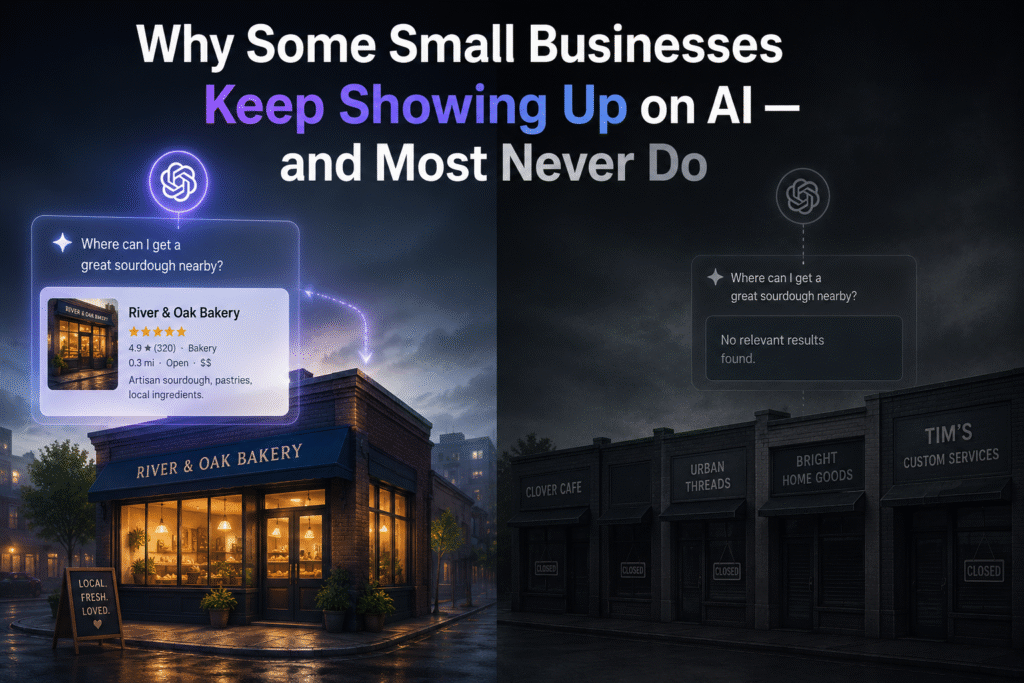
When someone types “best plumber near me” or “affordable digital agency in Delhi” into ChatGPT or Gemini, certain businesses get mentioned. Most do not. This is not luck. It is the result of a specific set of decisions business owners either made — or ignored.
Here is what separates the businesses that show up from the ones that stay invisible.
How AI Actually Decides What to Recommend
Large language models like ChatGPT, Gemini, and Perplexity do not use live search the way Google does. They are trained on enormous volumes of text scraped from the web — blog posts, directories, reviews, forums, news articles, and structured data. When a user asks for a recommendation, the AI draws from that training data and, increasingly, from real-time web retrieval.
If your business has no meaningful presence in that data, the model has nothing to pull from. You simply do not exist in its world.
The Real Reason Most Small Businesses Are Invisible to AI
The problem is not that AI ignores small businesses. The problem is that most small businesses have never given AI anything to find.
A business with no website, thin social profiles, and zero third-party mentions is functionally invisible to both search engines and language models. But even businesses with a decent website often miss the deeper requirements — consistent NAP data (Name, Address, Phone), structured schema markup, category-specific directory listings, and genuine customer language appearing in reviews and Q&A sections.
AI models trust sources that trust each other. If reputable platforms consistently reference your business in the same way, the model develops confidence in your existence and relevance.
What Businesses That Get Mentioned Are Doing Differently
They have a consistent digital footprint across platforms.
Their business name, address, phone number, and description appear the same way on Google Business Profile, Yelp, Justdial, IndiaMART, LinkedIn, and industry-specific directories.
They generate content that answers questions.
Blog posts, FAQs, and how-to guides that use natural language are exactly what language models train on. A bakery that publishes “How to order a custom wedding cake in Faridabad” is far more likely to appear in AI responses than one with only an Instagram page.
They collect and respond to reviews actively.
Reviews are one of the richest sources of authentic, keyword-dense, human-generated text. AI models pick up on patterns in review language when forming recommendations.
They are mentioned by others — not just themselves.
Press mentions, guest posts, podcast appearances, local news features, and citations from other websites all function as third-party validation that AI systems treat as trust signals.
They use structured data on their website.
Schema markup tells machines exactly what a business does, where it operates, what it sells, and who it serves. This is machine-readable language — precisely what LLMs and retrieval systems rely on.
Side-by-Side Comparison
| Factor | Businesses AI Mentions | Businesses AI Ignores |
|---|---|---|
| Website content | Detailed, question-answering pages | Thin or brochure-style only |
| NAP consistency | Identical across all platforms | Varies or missing on many platforms |
| Reviews | Frequent, responded to, keyword-rich | Few, outdated, or none |
| Directory presence | Listed on 10+ relevant directories | Google only, or none |
| Third-party mentions | Press, blogs, partnerships | Self-published only |
| Schema markup | Implemented and accurate | Absent |
| Content frequency | Regular updates and new pages | Static for months or years |
The GEO Concept You Need to Know
Search engine optimization (SEO) helped businesses rank on Google. A newer discipline — Generative Engine Optimization (GEO) — focuses specifically on making your business visible within AI-generated answers.
GEO is not a replacement for SEO. It builds on it. The core idea is that AI systems favor businesses that are easy to verify, consistently described, and frequently referenced across independent sources. Every piece of content you publish, every review you collect, and every directory you list on contributes to how confidently an AI model can recommend you.
Where Small Businesses Should Focus First
Start with what is already broken before chasing new tactics.
Audit your existing listings for NAP inconsistencies. Claim and complete your Google Business Profile fully — category, services, hours, photos, posts, and Q&A. Write at least five pages of content that directly answer the questions your customers actually ask. Get listed on three to five authoritative directories specific to your industry or city.
Then build outward. Reach out for one local press mention. Ask satisfied customers to leave detailed reviews. Add schema markup to your website. Publish one piece of content per month that a person in your city would realistically search for.
None of this is complicated. It is just consistent effort most business owners skip because the results are not immediate.
FAQs
Q. Does my business need to be famous for AI to mention it?
No. AI models recommend local and niche businesses regularly. What matters is the density and consistency of your digital presence, not your brand size. A well-documented local business will outperform a poorly documented regional chain.
Q.Does social media following help with AI visibility?
Indirectly. A large following does not directly influence LLM training data, but content published on social platforms that gets shared, indexed, and linked to does contribute. Focus on content quality over follower count.
Q.How long does it take to start appearing in AI responses?
There is no fixed timeline. Businesses that address all major gaps — consistent listings, content, reviews, and schema — typically begin seeing results within three to six months. It depends heavily on how competitive your category and location are.
Q. Is Google Business Profile still relevant for AI visibility?
Yes, significantly. Several AI tools with web retrieval capabilities pull directly from Google’s index, where GBP data is heavily weighted. A complete and active GBP is one of the highest-leverage actions a small business can take.
Q. Can a business pay to appear in AI recommendations?
Currently, organic AI recommendations from models like ChatGPT and Gemini are not influenced by paid advertising. Visibility is earned through content, citations, and trust signals — not ad spend.
Q. What is the single most important thing a small business can do today?
Publish one detailed, genuinely helpful page on your website that answers the top question your customers ask — and make sure your business name, address, and phone number appear correctly on Google, Bing Places, and at least three industry directories.
The Businesses That Win Are the Ones Machines Can Understand
AI does not have intuition. It does not visit your shop, talk to your staff, or judge your product quality directly. It reads what has been written about you — and how much of it exists, how consistent it is, and how many independent sources confirm it.
The small businesses that keep showing up in AI answers are not doing anything exotic. They have simply built a presence that is readable, verifiable, and referenced broadly enough for a language model to trust.
That is the bar. And for most small businesses, it is still wide open.
Discover more from
Subscribe to get the latest posts sent to your email.