If you are selling on the Government e-Marketplace and your products are sitting in “pending” status for weeks, vendor assessment might be the reason nobody told you about. Many sellers complete their GeM registration, upload their catalogues, and then wonder why their products are not going live. The answer, in most cases, is a mandatory vendor assessment that they skipped or did not know existed.
This guide explains what vendor assessment is on GeM, why the government requires it, which product categories fall under it, and what you need to do to clear it.
What Is Vendor Assessment on GeM?
Vendor assessment is a quality verification process that GeM conducts through a third-party body called QCI, which stands for Quality Council of India. When you apply for vendor assessment, QCI checks whether your business actually manufactures or supplies what you claim, whether your quality standards meet government procurement norms, and whether your infrastructure, machinery, and processes are genuine.
Think of it as a background check on your business, not just your documents.
A seller named Ramesh from Ludhiana registered on GeM to sell industrial safety helmets. He uploaded his catalogue, set competitive prices, and waited for orders. Three weeks passed and his products stayed in pending. When he contacted GeM support, he was told his product category required vendor assessment and he had not initiated it. His catalogue could not go live until QCI verified his manufacturing unit.
That is the kind of situation vendor assessment can put you in if you are not prepared.
Why Does GeM Require Vendor Assessment?
The Government e-Marketplace is used by central and state government departments, PSUs, and autonomous bodies. These buyers spend public money, and they need assurance that the products they procure are genuine, safe, and of the promised quality.
Without a verification mechanism, any seller could list sub-standard or counterfeit products. Vendor assessment closes that gap. It ensures that only sellers with verified production capacity and quality standards can supply certain categories of goods.
This is also why government buyers on GeM tend to trust assessed sellers more. An assessed seller badge signals credibility that non-assessed sellers do not carry.
Who Conducts the Vendor Assessment?
QCI, the Quality Council of India, is the official agency authorised by GeM to conduct vendor assessments. QCI operates under the Ministry of Commerce and Industry and has been running quality verification programmes across Indian industries for years.
Once you apply for vendor assessment through the GeM portal, QCI assigns an assessor who either visits your premise physically or conducts the assessment digitally depending on your product category and order value.
Types of Vendor Assessment on GeM
GeM offers two types of vendor assessments based on turnover and product category.
| Assessment Type | Who It Applies To | Mode |
|---|---|---|
| Self-Declaration | Sellers with turnover below ₹10 crore and in non-mandatory categories | Online declaration, no site visit |
| QCI Vendor Assessment | Sellers in mandatory categories or above the turnover threshold | Physical or digital verification by QCI |
Sellers in the QCI assessment track pay a fee to QCI for the assessment. The fee varies by business size and category. For micro enterprises it is lower than for medium or large businesses.
Which Product Categories Require Vendor Assessment on GeM
Not every product on GeM requires a QCI assessment. GeM divides products into two groups: those where vendor assessment is mandatory and those where a self-declaration is enough.
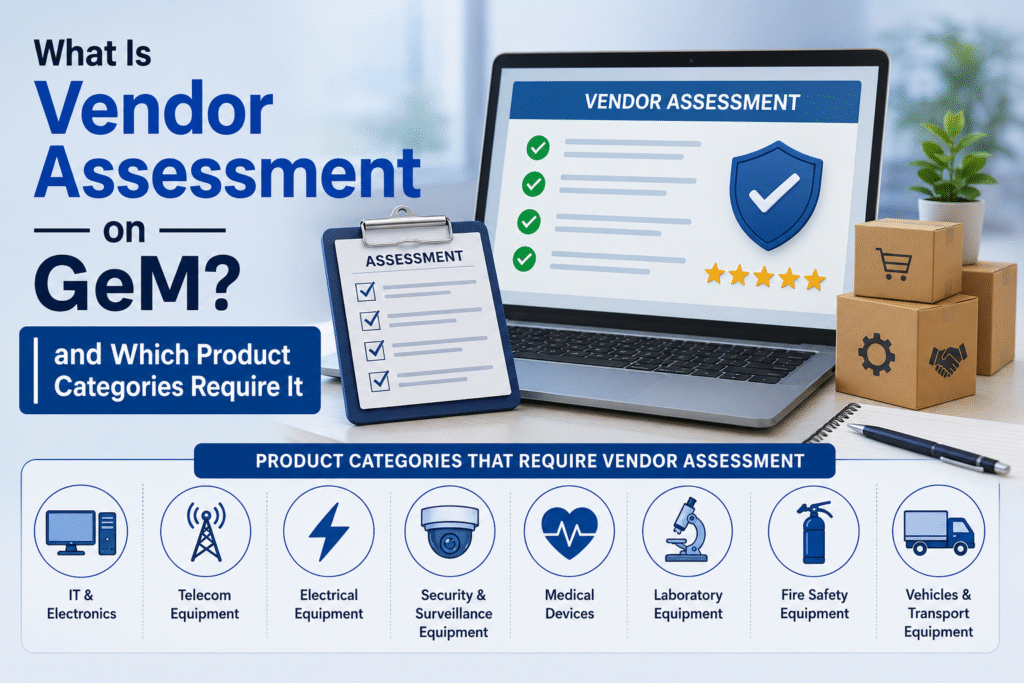
The following types of product categories generally fall under mandatory vendor assessment.
Safety and personal protective equipment
such as helmets, safety shoes, gloves, fire-resistant garments, and harnesses. These directly affect the physical safety of government workers, so QCI verification is non-negotiable.
Electrical and electronic equipment
such as wires, cables, switches, LED lights, solar panels, and UPS systems. The government procures these in bulk, and substandard electrical products create fire and infrastructure risk.
Medical and health-related products
such as hospital furniture, diagnostic kits, surgical consumables, and first-aid supplies. These require quality proof before government hospitals and dispensaries can purchase them.
IT hardware
such as desktops, laptops, servers, printers, and networking equipment. OEM authorisation and quality standards must be verified before listing.
Water and sanitation equipment
such as pumps, pipes, water purifiers, and sanitation systems. These are high-priority infrastructure procurement items.
Textile and uniform items
such as police uniforms, school uniforms, and official workwear that meet government specifications.
Furniture and office equipment
above certain value thresholds that need to meet BIS or ISO standards.
The exact list is updated by GeM periodically. You should always check your product category page on the GeM portal to confirm whether vendor assessment applies to your specific HSN code.
How to Check If Your Product Requires Vendor Assessment?
Log in to your GeM seller account and go to the product catalogue section. When you try to add a product under a specific category, the portal will show you whether vendor assessment is mandatory before your listing can go live.
You can also check this during the product listing flow. If a banner or alert appears asking you to initiate vendor assessment, that category is under the mandatory track.
How to Apply for Vendor Assessment on GeM?
Once you confirm your product requires assessment, the process works like this.
Go to your seller dashboard and navigate to the vendor assessment section. Click on “Apply for Vendor Assessment” and select the relevant product category. You will be redirected to the QCI portal where you fill in your business details, manufacturing or supply information, and upload supporting documents.
QCI will schedule an assessment. For physical assessments, an assessor visits your factory or warehouse. For digital assessments, they may ask for a video walkthrough, test reports, or BIS certification documents.
After the assessment is complete and you clear it, your vendor assessment status on GeM is updated and your catalogues in that category become eligible to go live.
How Long Does the Assessment Take?
The timeline varies. A digital assessment can be completed in 7 to 15 working days if your documents are in order. A physical site visit assessment may take 3 to 6 weeks depending on assessor availability in your area.
Sellers in categories like safety equipment often wait longer because demand for QCI assessors in those categories is high. The best way to avoid delays is to start the assessment process before you plan to list products, not after.
What Happens If You Skip Vendor Assessment?
If your product category requires mandatory vendor assessment and you have not completed it, your catalogue will not go live on GeM. Government buyers will not be able to see or purchase your products even if everything else in your profile is complete.
Some sellers try to list products under a similar but non-mandatory category to bypass the assessment. GeM’s compliance checks catch these mismatches during category validation, and it can lead to your listing being rejected or your account being flagged.
Does Vendor Assessment Expire?
Yes. Vendor assessment is not a one-time clearance that lasts forever. GeM requires sellers to renew their vendor assessment periodically. The renewal period is typically every two to three years, but it can vary by category.
If your assessment expires and you do not renew it, your catalogue in that category can be delisted. Set a reminder well before your assessment expiry date so you do not lose active listings.
Frequently Asked Questions
Q1. What is vendor assessment on GeM in simple terms?
Vendor assessment is a quality check done by QCI on behalf of GeM to verify that you genuinely manufacture or supply what you have listed on the portal. It is mandatory for certain product categories before your catalogue can go live.
Q2.Is vendor assessment free on GeM?
No. If you fall under the QCI assessment track, you need to pay a fee to QCI. The fee depends on your business size. Micro enterprises pay a lower fee than medium or large businesses. Self-declaration assessment has no fee.
Q3.Can I sell on GeM without vendor assessment?
Yes, but only in categories where vendor assessment is not mandatory. If your product category requires it, you cannot sell without completing the process.
Q4.What documents are needed for vendor assessment?
Commonly required documents include your GST certificate, PAN, Udyam registration, factory licence, BIS or ISO certification if applicable, test reports, and photographs of your manufacturing unit or storage facility.
Q5.What is the difference between self-declaration and QCI assessment?
Self-declaration means you fill out an online form confirming your quality standards, and no physical visit is required. QCI assessment involves a trained assessor verifying your business in person or digitally. Self-declaration applies to lower-risk or lower-turnover sellers.
Q6.My product was listed without vendor assessment earlier. Why is it suddenly required?
GeM updates its mandatory assessment list periodically. If a category was previously under self-declaration and has now been moved to mandatory QCI assessment, existing listings may also be required to comply. Check your seller dashboard for notifications.
Q7.Can vendor assessment rejection be appealed?
Yes. If QCI finds your business does not meet the required standards, they will share a report with the reasons. You can address the gaps, improve your setup or documentation, and reapply for assessment.
Vendor assessment is not a roadblock designed to trouble small sellers. It is the mechanism that makes GeM trustworthy for government buyers who need to spend public funds on genuine, quality products. If you are in a category that requires it, the sooner you initiate the process, the sooner your catalogue starts getting real government orders.
Discover more from
Subscribe to get the latest posts sent to your email.