
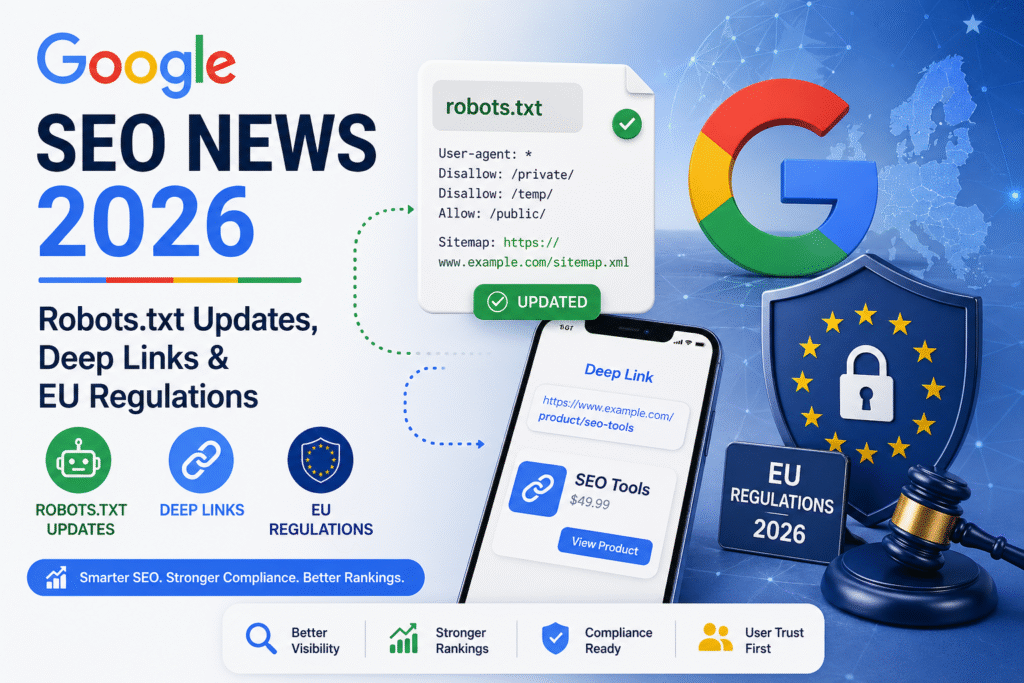
What Is Changing in Google SEO Right Now?
Google SEO in 2026 is not sitting still. Within the span of a single week, Google expanded its robots.txt documentation, formalized best practices for deep links in search snippets, and the European Commission stepped in with regulatory proposals that could reshape how search data flows across the web. For anyone managing a website, running a content strategy, or advising clients on organic search, these three developments land at the same time and demand attention together.
This is not a theoretical conversation. The documentation changed on April 20, 2026. The EU proposal is open for consultation through May 1. And the robots.txt expansion is actively in progress, with Google’s own team publicly discussing it. Here is what each update means and what you should do about it.
Google’s Robots.txt Documentation Is Expanding
Google is making its robots.txt documentation significantly more detailed, and the source of that expansion is real-world usage data. Gary Illyes and Martin Splitt discussed the project publicly on the Search Off the Record podcast, confirming that Google analyzed the most frequently used unsupported rules across millions of URLs indexed by the HTTP Archive. The team plans to document the top 10 to 15 most-used unsupported rules that go beyond the four basics: user-agent, allow, disallow, and sitemap.
Illyes also mentioned that the robots.txt parser may expand the list of typos it accepts for “disallow,” though no timeline was committed to. This signals a shift in how Google thinks about robots.txt — from a minimal spec to a living document that reflects actual webmaster behavior.
For 2026, this expansion matters because robots.txt is increasingly being treated as a policy document rather than just a crawler control mechanism. The question of which bots to allow now has real consequences on content licensing, AI training, and organic visibility — making this one of the most strategically important files on your server.
Deep Links Now Have Official Best Practices From Google
On April 20, 2026, Google updated its snippet documentation to include a dedicated section on “Read more” deep links in search results. These are the anchor links that appear within a snippet and take users directly to a specific section of a page — not just the top of it. Google has now listed three best practices that increase the likelihood of these links appearing in your results.
Watch a detailed breakdown of how deep links work in Google Search and what you can do to earn them for your pages on our YouTube channel — the video covers real examples and a step-by-step audit process you can run today.
The three signals Google has formalized are:
1. Content must be immediately visible on page load.
If your content is hidden behind expandable accordions, tabbed interfaces, or collapsible sections, Google’s deep linking system cannot point to it. The section has to exist in the rendered page from the first moment a user lands. FAQ sections, step-by-step guides, and comparison tables are the most commonly affected content types. Any design decision that folds content behind a toggle is now a direct tradeoff against deep link eligibility.
2. Avoid JavaScript that overrides scroll position on page load.
Deep links work by appending a hash fragment to a URL, such as yourdomain.com/article#section-three, and relying on the browser to scroll the user directly to that section. If JavaScript forces the page to scroll back to the top on load, the deep link breaks entirely. The user lands at the top, the anchor is ignored, and the experience Google intended disappears. This is a technical issue that affects more sites than most teams realize.
3. Page structure should support direct section linking.
Google’s language around this is framed as increasing likelihood, not guaranteeing results. Following all three best practices does not guarantee deep links will appear. What it does is remove the structural barriers that prevent them.
The strategic implication is significant. If a page on your site already has a “Read more” deep link for one section, that section’s structure is a working template. Replicating that structure across other sections of the same page gives those sections a better chance at the same treatment.
The EU Is Stepping Into Search — and AI Chatbots Are Now in Scope
The third development this week comes from Brussels, not Mountain View. The European Commission has proposed measures that explicitly extend search-engine data-sharing eligibility to AI chatbots under the Digital Markets Act. This is a meaningful shift in how regulators are defining the category of “search engine.”
If the proposal survives the consultation period ending May 1, AI chatbots that compete with Google in the EU market could gain access to anonymized search signals that Google currently shares only with traditional search competitors. The downstream effect is that AI products could use that data to improve their retrieval and ranking systems, which in turn affects which content they cite and surface.
For publishers and content creators operating in or targeting the EU and EEA, the practical consequence is that the scope of where your content signals flow could broaden. For everyone else outside the EU, the direct regulatory effect is zero — but the category definition being established here is likely to be cited in future proceedings globally.
The harder conversation this raises is around robots.txt and Google-Extended. Blocking Google-Extended can prevent your content from being used to train Gemini, but it does not prevent your content from appearing in AI Overviews if Google has already indexed the page. Publishers cannot currently allow traditional snippets while blocking LLM training. That granularity does not exist yet, and European publishers are pushing hard for it through the complaint process.
Quick Comparison: What Changed and What It Means for You
| Update | What Google Did | Your Action |
|---|---|---|
| Robots.txt Expansion | Plans to document 10–15 unsupported rules from real-world usage data | Audit your robots.txt against updated documentation when released |
| Deep Links Documentation | Published 3 best practices for “Read more” deep links on April 20, 2026 | Remove hidden/collapsed content, fix JS scroll overrides |
| EU DMA Proposal | Proposed extending search data sharing to AI chatbots | Monitor May 1 consultation outcome if targeting EU audiences |
| Google-Extended Limitation | Blocking training does not stop AI Overview appearances | Review your opt-out strategy and understand its actual scope |
| AI Mode Expansion | Users can now launch AI agents directly from AI Mode in Search | Structure content for semantic depth, not just keyword targeting |
What This Means for Your SEO Strategy Right Now
Three separate updates landing in the same week is not coincidence — it reflects a broader shift in how Google, regulators, and the web are all renegotiating the rules of search simultaneously.
The robots.txt expansion means technical audits now require a sharper eye on which crawlers you are allowing and which you are blocking, and why. A file you set up years ago may be silently blocking or permitting behavior that has material consequences today.
The deep link update is one of the most actionable changes released this year. The audit is straightforward: go through your highest-traffic pages and identify any content sitting behind expandable elements. If key information requires a click to reveal, it is invisible to Google’s deep linking system. Fixing this does not require a redesign — it requires a structural decision about what lives above the fold and what does not.
The EU development is the slowest-moving of the three but potentially the most consequential long term. How the Commission defines the line between an AI chatbot and an AI chatbot that qualifies as a search engine will shape regulatory conversations well beyond 2026. If you operate in the EU, May 1 is a date worth watching.
Frequently Asked Questions
Q1.What is the robots.txt expansion Google announced in 2026?
Google is analyzing real-world robots.txt usage data from the HTTP Archive and plans to add documentation for the 10 to 15 most commonly used unsupported rules. This is an expansion of the official specification to reflect how webmasters actually use the file, not just how Google originally defined it.
Q2.What are Google’s deep link best practices released in April 2026?
Google published three best practices on April 20, 2026: content must be immediately visible on page load without requiring a click to expand, JavaScript should not override the browser’s scroll position on load, and page structure should support direct section linking via hash fragments.
Q3.Does blocking Google-Extended stop my content from appearing in AI Overviews?
No. Google-Extended blocks your content from being used to train Gemini, but if Google has already indexed your pages, it can still summarize or use that content in AI Overviews. The two controls are separate and do not overlap.
Q4.What is the EU Digital Markets Act proposal about AI chatbots?
The European Commission has proposed extending search-engine data-sharing eligibility to AI chatbots under the DMA. If finalized, AI products competing with Google in the EU could access the same anonymized search signals Google shares with traditional search engine competitors.
Q5.How does the deep link update affect accordion or tabbed content?
Content hidden behind expandable sections, tabbed interfaces, or collapsible elements is not visible to Google’s deep linking system on page load. If you want deep links to point to a specific section, that section must be fully rendered and visible without any user interaction required.
Q6.Should I update my robots.txt right now based on the expansion announcement?
Not yet. Google has signaled plans but has not released the expanded documentation. The right move is to audit your current file against the existing specification, understand what each directive is doing, and prepare to review again once the updated documentation is published.
Q7.What does the EU proposal mean for content creators outside Europe?
The direct regulatory effect outside the EU is zero. However, how the Commission defines the boundary between AI chatbots and search engines is likely to influence future regulatory proceedings in other regions, making it worth monitoring even if you do not target European audiences.
Discover more from
Subscribe to get the latest posts sent to your email.