
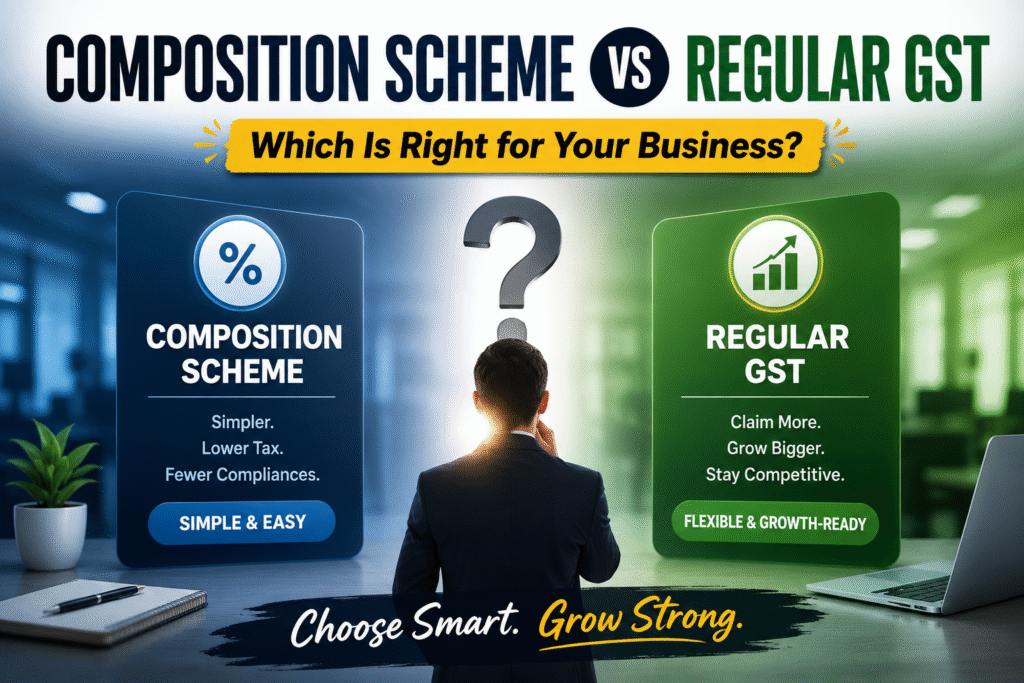
When you register for GST in India, you face one foundational decision: the Composition Scheme or the Regular GST regime. Both are legal, both are valid — but the wrong choice can quietly drain your cash flow, create unnecessary compliance burden, or shut you out of certain markets. This guide breaks down exactly what each option means for your business.
What is the Composition Scheme?
The Composition Scheme is a simplified GST option built for small businesses. Instead of calculating tax on every transaction, you pay a fixed percentage of your total annual turnover as tax — no input tax credit, no complex invoicing, minimal paperwork.
Businesses with an annual aggregate turnover up to Rs. 1.5 crore (Rs. 75 lakh for special category states) are eligible. Service providers can opt in if their turnover does not exceed Rs. 50 lakh, subject to certain conditions. Tax rates range from 0.5% to 6% of turnover, depending on whether you are a manufacturer, trader, or restaurateur.
What is the Regular GST Scheme?
The Regular GST regime is the standard model. You collect GST from your customers, pay GST on your purchases, and remit the net difference to the government. The key advantage is Input Tax Credit — you can claim back the tax you paid on business inputs, reducing your total liability significantly.
There is no upper turnover limit under the Regular Scheme. Monthly or quarterly GSTR-1 and GSTR-3B returns are mandatory, along with an annual reconciliation return.
| Feature | Composition Scheme | Regular GST Scheme |
|---|---|---|
| Turnover limit | Up to Rs. 1.5 crore (traders/manufacturers); Rs. 50 lakh (services) | No limit |
| Tax rate | Fixed % on turnover (0.5%–6%) | Standard slabs (5%, 12%, 18%, 28%) |
| Input Tax Credit | Not available | Fully available |
| Inter-state supply | Not allowed | Allowed |
| E-commerce sales | Not allowed (as supplier) | Allowed |
| Tax invoice | Cannot issue GST-compliant invoice | Must issue full tax invoice |
| Return frequency | Quarterly CMP-08 + Annual GSTR-4 | Monthly/Quarterly GSTR-1 + GSTR-3B |
| Compliance burden | Low | Moderate to high |
| Best suited for | Local retailers, small manufacturers | Growing businesses, B2B suppliers, exporters |
When the Composition Scheme makes sense?
If your business is primarily B2C — meaning most customers are end consumers who cannot claim ITC themselves — the Composition Scheme is often the more practical choice. Your customers lose nothing by not receiving a tax invoice, and you save significantly on compliance time and accounting costs.
It also works well when your input costs are low relative to revenue. Since ITC is unavailable, you need to check whether the fixed tax on turnover is lower than your effective net GST liability under the Regular Scheme. A local grocery store, a small sweets manufacturer, or a neighbourhood restaurant with all-local clientele are ideal candidates. The simplicity alone reduces the need for a dedicated accountant and lowers the risk of filing errors.
When the Regular GST Scheme is the better fit?
Any business that sells to other registered businesses must think carefully before opting for the Composition Scheme. A B2B buyer registered under Regular GST needs a valid tax invoice to claim ITC. If you are on the Composition Scheme, you cannot issue one — which means your buyers lose their credit, and many will simply prefer a Regular GST dealer.
If you sell across state lines, operate on e-commerce platforms, or deal in exports, the Composition Scheme disqualifies you outright. Businesses with high input costs — heavy raw material purchases, large freight expenses, machinery procurement — also benefit more from ITC, which can bring down the effective tax rate considerably. And as your turnover approaches Rs. 1.5 crore, you will be required to migrate anyway. Planning ahead avoids a disruptive mid-cycle switch.
The ITC factor: a practical illustration
Consider a small furniture maker with an annual turnover of Rs. 80 lakh. He buys wood, hardware, and finishes worth Rs. 30 lakh, paying 18% GST on inputs — that is Rs. 5.4 lakh. Under the Regular Scheme at 12% output GST (Rs. 9.6 lakh), after ITC his net liability is Rs. 4.2 lakh. Under the Composition Scheme at 1% of turnover, he pays just Rs. 80,000. Here the Composition Scheme is dramatically cheaper — but the math shifts entirely for businesses with thinner margins and heavier input purchases. Always run the numbers against your specific cost structure before deciding.
Frequently Asked Questions
Q. Can I switch from the Composition Scheme to the Regular Scheme mid-year?
Yes. You can voluntarily opt out by filing Form GST CMP-04. Once you do, you shift to the Regular Scheme from the beginning of the financial year or from the date you become ineligible — whichever applies.
Q. Can a Composition dealer collect GST from customers?
No. A Composition dealer cannot charge GST separately on their bills. The tax is paid out of their own pocket as a percentage of turnover. They must mention “Composition Taxable Person” on their bill of supply but cannot issue a tax invoice.
Q. What happens if my turnover crosses the Composition limit during the year?
You must immediately stop availing the Composition Scheme and register under the Regular Scheme. You become liable to pay Regular GST from the day the threshold was crossed, not just from the next financial year.
Q. Is the Composition Scheme available for all businesses?
No. Certain categories are excluded — manufacturers of notified goods such as ice cream, pan masala, and tobacco; businesses making inter-state supplies; casual and non-resident taxable persons; and suppliers operating through e-commerce operators liable to collect TCS.
Q. Does a Composition dealer need to maintain detailed accounts?
The scheme reduces documentation significantly. You still need basic records of purchases, sales, and stock, but you do not need HSN-wise invoicing or ITC ledger reconciliation. Quarterly payment through CMP-08 and an annual return in GSTR-4 are the primary compliance requirements.
Q. Can a service provider opt for the Composition Scheme?
Yes, but only under the special composite window for service providers, with a turnover cap of Rs. 50 lakh. Pure service providers were initially excluded but were brought within a modified composition option through a later amendment to the CGST Act.
The bottom line
There is no universally superior choice. The Composition Scheme offers simplicity, lower compliance costs, and predictable tax outgo — ideal for small, local, B2C businesses with modest input costs. The Regular Scheme offers ITC benefits, broader market access, and scalability — essential for B2B operations, exporters, and any business on a growth trajectory.
Run the numbers on your input tax versus output tax. Assess your customer base. Consider where you want the business to be in three years. If your operations are local and below the threshold, the Composition Scheme can save real money and time. If you have growth ambitions, registering under the Regular Scheme from the start avoids a painful mid-journey transition.
When in doubt, consult a qualified GST practitioner who can model both scenarios against your actual financials. The right choice today protects your margins and your compliance standing tomorrow.
Discover more from
Subscribe to get the latest posts sent to your email.