
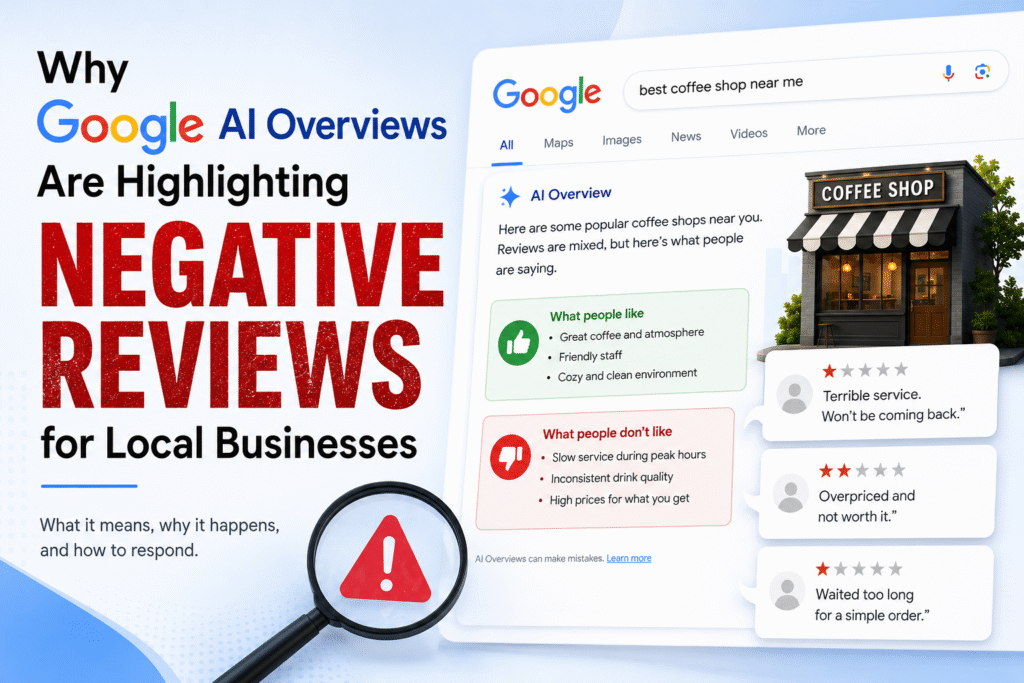
You optimized your Google Business Profile. You responded to reviews. You built a decent online reputation the hard way. And now, right at the top of Google’s search results, an AI-generated box is summarizing complaints about your business that a handful of unhappy customers left two years ago.
This is not a glitch. It is how Google AI Overviews are designed to work, and understanding why it happens is the first step toward doing something about it.
What Google AI Overviews Actually Do?
Google AI Overviews (AIOs) are AI-generated summaries that appear above all organic search results. They launched at scale in May 2024 and now reach over 1.5 billion users monthly across more than 200 countries. Their purpose is to give searchers a direct answer without requiring them to click through to a website.
For local businesses, this creates an immediate problem. When a potential customer searches for your business name combined with words like “reviews,” “complaints,” or “reliable,” the AIO does not simply show your star rating. It synthesizes content from multiple sources, including review platforms, forums, Reddit threads, and third-party sites, and presents a blended summary at the very top of the page.
That summary is what your prospect reads first. In many cases, it is what they read exclusively.
How LLMs Decide What to Surface?
Large Language Models powering AI Overviews do not think the way a human editor would. They do not weigh intent, fairness, or recency the way a person reviewing your reputation might. Instead, they operate on pattern recognition, prioritizing signals that appear credible, specific, and repeated across multiple independent sources.
When evaluating businesses, AI engines actively scan for negative reviews on complaint sites, Reddit discussions, forum threads, and customer support complaints that have made it into public view. The critical distinction is that users are not always asking about problems, but AI engines interpret “helping” as including negative signals from your brand footprint.
Research from BrightEdge shows that Google AI Overviews surface negative sentiment in approximately 2.3% of brand mentions, and that Google AI Overviews are 44% more likely than ChatGPT to criticize brands overall.
The four specific signals that determine which complaints get pulled into an AI Overview are important for every local business owner to understand.
The Four-Signal Model: Why Certain Negative Reviews Get Amplified?
Q1 2026 analysis surfaces four consistent patterns in what AI engines cite: recency combined with volume, specificity that names features or services, platform authority such as Reddit and major review sites, and recurrence of the same complaint across multiple independent sources. The complaints that satisfy all four criteria are the ones that show up unprompted in queries where users were looking for solutions, not problems.
| Signal | What It Means | Why It Matters |
|---|---|---|
| Recency + Volume | Multiple complaints within a short time window | Fresh, clustered negativity reads as a trending pattern to LLMs |
| Specificity | Reviews that name exact services, staff, or outcomes | Vague posts get filtered out; detailed ones are weighted as evidence |
| Platform Authority | Content from Reddit, Yelp, Trustpilot, Google Reviews | AI engines trust high-authority domains more than unknown sites |
| Cross-Source Recurrence | Same complaint appearing on multiple platforms | Repetition across sources signals consensus, not just one bad experience |
A single one-star review rarely makes it into an AI Overview. A cluster of detailed, recent complaints spread across Yelp, Reddit, and Google Reviews almost certainly will.
The Amplification Problem No One Warned You About
AI models like ChatGPT, Claude, and Google’s AI Overviews operate on probability. They predict what information is most relevant or accurate based on patterns in their training data. If your brand is consistently mentioned with negative reviews, AI will likely summarize your brand unfavorably, often amplifying outdated or damaging perceptions without you even realizing it.
Before AI Overviews, reputation management was primarily a search position problem. The objective was clear: ensure that authoritative, accurate, and representative content occupied the first-page positions. Negative content on page three caused no damage. That framework is no longer sufficient, because AI Overviews do not simply surface pages. They synthesize information from multiple sources and present a summary answer above every organic result.
This is why local businesses that felt safe with a 4.1-star rating and managed first-page results are suddenly seeing negative summaries appear in AI-generated answers. The old rules of reputation management have fundamentally changed.
Why Local Businesses Are Particularly Exposed?
A Q2 2025 study from Whitespark found that AI Overviews were appearing for 68% of local searches. That number has continued to grow. For service-based businesses where trust is the deciding factor, a negative AI-generated summary appearing before any organic result can be business-ending before a prospect ever reaches your website.
Google’s AI Overviews increasingly synthesize review content to answer consumer queries about local businesses. Businesses with a rich, high-quality review corpus, including thoughtful and substantive responses, are more likely to be represented favorably in AI-generated search summaries. Conversely, businesses with thin, unanswered, or generic review activity may be underrepresented or represented negatively in these AI-driven responses.
The problem compounds for businesses that have been slow to respond to reviews. An unanswered negative review carries more weight in an LLM’s assessment because it signals to the AI that the business has not disputed or resolved the complaint.
What You Can Do Right Now?
The solution is not to panic over reviews you cannot remove. It is to build a stronger positive signal environment that competes with and eventually displaces the negative signals being picked up by AI systems.
Respond to every negative review with specificity.
Generic responses carry no weight with AI systems. A detailed, professional response that addresses the specific complaint by name tells the LLM that the issue was acknowledged and resolved.
Generate a consistent stream of recent, detailed positive reviews.
Recency matters. A flood of positive reviews from the past 90 days will outweigh older negative ones in AI synthesis because the system reads recent volume as the current state of your business.
Publish verifiable case studies and customer success content on your own website.
Specificity with metrics and timeframes helps ensure LLMs treat content as credible evidence rather than marketing copy. Linking to customers’ LinkedIn profiles or business websites reinforces that the review is real and substantiated.
Audit how AI currently describes your business.
Open ChatGPT or Perplexity and search “pros and cons of [your business name].” What appears in that answer is a close approximation of what Google’s AI Overview will surface. If the answer includes specific complaints, those are the signals you need to address at the source.
Build citations on high-authority platforms.
Identifying high-authority “Best of” lists or industry roundups where your brand is missing and reaching out to editors with unique expert insight seeds high-trust citations that AI engines prioritize when synthesizing reputation summaries.
The Bigger Picture for Local SEO
Brands cited in AI Overviews earn 35% more organic clicks and 91% more paid clicks compared to brands that are not cited. This means AI Overviews are not only a threat, they are an opportunity. The businesses that understand how LLMs synthesize reputation data and actively shape their signal environment will gain an asymmetric advantage over competitors who are still playing by 2022 rules.
The businesses that ignore it will watch AI summaries define their reputation for every prospect who searches their name, with no ability to intervene after the fact.
Frequently Asked Questions
Q: Can I ask Google to remove a negative review that keeps appearing in AI Overviews?
Getting a review removed requires it to violate Google’s content policies. If the review is genuine, even if unfair, removal is unlikely. The more effective strategy is building enough positive, authoritative signal that the negative content becomes statistically irrelevant to the AI’s synthesis.
Q: Does responding to negative reviews actually affect what AI Overviews show?
Yes. An unanswered complaint reads to an LLM as an unresolved problem. A detailed, professional response that addresses the specific issue signals resolution. It also adds positive, authoritative content tied to the original review, which shifts the overall sentiment pattern AI engines detect.
Q: My business has a 4.5-star average. Why is AI still surfacing complaints?
Star ratings alone are not what AI Overviews analyze. They look at the content of individual reviews, forum discussions, third-party mentions, and the recurrence of specific complaints across platforms. A high average rating does not prevent specific, detailed, cross-platform negative content from being surfaced.
Q: Which platforms does Google’s AI pull review data from?
Google prioritizes high-authority platforms including Google Business Profile, Yelp, Trustpilot, Reddit, industry-specific forums, and news coverage. Content from these sources carries significantly more weight than reviews on low-authority or obscure sites.
Q: How long does it take for positive reputation signals to push out negative AI summaries?
There is no fixed timeline. The speed depends on the volume, recency, and specificity of new positive signals relative to existing negative ones. Businesses that generate consistent, detailed positive reviews and third-party mentions typically begin to see shifts in AI-generated summaries within three to six months of focused effort.
Q: Is this only a Google problem or do other AI tools do the same thing?
This affects all AI-powered search tools. ChatGPT, Perplexity, Claude, and others draw on public review data and synthesize brand sentiment. BrightEdge data shows that Google AI Overviews surface negative sentiment in 2.3% of brand mentions while ChatGPT does so in 1.6%. Google is the most aggressive, but no AI search platform is immune to surfacing negative signals when they are strong enough.
Final Word from BizWithTech
The rules of local reputation management have changed, and they changed quickly. AI Overviews do not care about your average star rating. They care about the specificity, recency, authority, and cross-platform recurrence of every signal associated with your business name.
The businesses that treat AI-generated summaries as a new layer of their reputation infrastructure, rather than something that just happens to them, will be the ones that survive and thrive in this search landscape. Start auditing your signal environment today. The AI is already forming an opinion about your business. The only question is whether you are shaping that opinion or ignoring it.
Discover more from
Subscribe to get the latest posts sent to your email.