
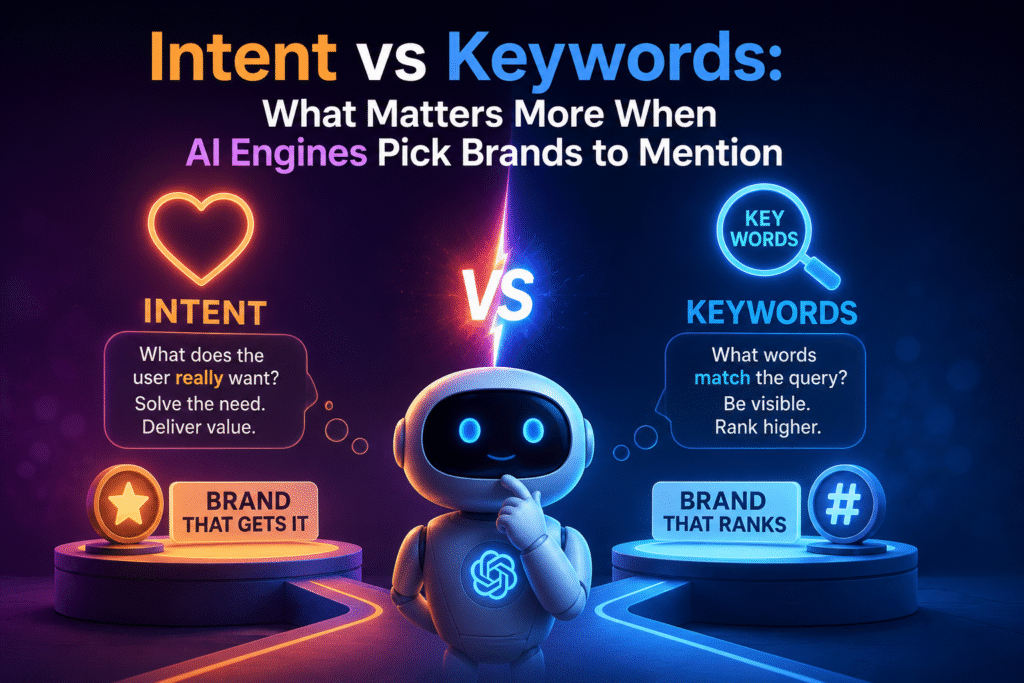
Most business owners still think AI search works like Google. Type the right keyword, get the right ranking. But a recent study changes that assumption completely.
Peec AI analyzed nearly 38,000 AI responses across five major engines, including ChatGPT, Gemini, Perplexity, Google AI Mode, and Google AI Overviews. The goal was simple. Does the exact wording of a prompt change which brands AI recommends?
The answer surprised a lot of marketers. Wording matters far less than intent.
This blog breaks down what that means for your business and how you should think about AI visibility going forward.
What Is the Difference Between Intent and Keywords?
Keywords are the exact words someone types. Intent is the actual need behind those words.
Two people can ask completely different questions and mean the same thing.
One person types “best noise-cancelling headphones under $200.” Another types “which budget over-ear headphones have good noise reduction.” The words are different. The need is identical.
Search engines like Google have always cared about keywords. AI engines work differently. They try to understand what you actually want, not just what you typed.
How the Study Measured This?
The researchers did not guess. They used a method called cosine similarity to measure how close two prompts are in meaning, not in spelling.
A score of 1.0 means two prompts mean exactly the same thing. A score closer to 0 means they are talking about very different things.
They ran two studies.
Study A used 288 real human-written prompts covering two different intents, producing over 17,000 chat responses.
Study B used 54 base prompts across 18 industries, then created small wording variations of each one, producing more than 20,000 chat responses.
Every prompt was run multiple times to account for natural variation in AI answers.
Insight 1: Most Human Prompts Mean the Same Thing
People type questions differently, but their underlying meaning rarely changes that much.
The study found that 88 percent to 92 percent of human prompt pairs had a similarity score above 0.50. Around 95 percent scored above 0.40.
In simple terms, most of the ways people phrase a question are mathematically close to each other, even if the words on the surface look nothing alike.
Example: “CRM software” and “customer relationship management tool” share almost no common words. But to an AI engine, they point at the exact same need.
Insight 2: Wording Only Hurts Visibility Past a Certain Point
Brand mentions stayed stable as long as prompt similarity remained above 0.50 to 0.60. Visibility only dropped sharply when prompts drifted into the 0.35 to 0.39 similarity range, a drop of nearly 50 percent.
This means small differences in phrasing rarely change which brands AI recommends. Only major shifts in meaning cause real damage.
There is one exception worth remembering. Similar-looking words can sometimes mean completely different things.
“Car rental Charleston” and “car rental Charlestown” look 95 percent similar in wording. But they refer to two different cities with two different commercial intents entirely.
If a core detail changes, such as a location, product type, or brand name, treat it as a new intent rather than a variation of the same one.
Insight 3: How You Ask Matters as Much as What You Ask
The format of a prompt changes how many brands an AI engine surfaces.
| Prompt Style | Effect on Brand Visibility |
|---|---|
| List or ranking request | Up to 20 percent more brands mentioned |
| Keyword-style prompt | Up to 25 percent more brands mentioned |
| Open-ended question | Fewer brands mentioned |
| Persona-style prompt (“You are a consultant…”) | Often shifts toward educational answers, fewer brand names |
| Added constraints (budget, features) | Mixed effect depending on the engine |
Adding more filler or conversational words made no real difference. The structure of the prompt mattered far more than its length.
Example: “Best CRM small business 2026” tends to surface more brand names than “Can you help me understand what CRM tool might work well for my small business?”
Insight 4: The Buying Stage Changes Everything
Not every type of search behaves the same way when wording changes.
Top-of-funnel queries are broad and educational, like “What is a CRM?” These stay stable even when phrasing changes a lot.
Middle-of-funnel queries are the riskiest. These are unbranded, commercial searches like “best CRMs for a small remote team.” Small wording changes here can completely shift which brands appear.
Bottom-of-funnel queries already include a brand or product name, so they tend to stay stable since everything is anchored around that name.
This is the most important takeaway for any business trying to track its AI visibility. Your middle-of-funnel searches deserve the most attention and the most variations tracked, since this is where wording actually decides who gets mentioned.
Insight 5: Every AI Engine Behaves Differently
The direction of the effect was consistent everywhere, but the intensity varied a lot.
Gemini recovers fastest. Its sensitivity to wording fades quickly once prompts move past the lowest similarity range.
Google AI Overviews showed the most persistent sensitivity in the middle-of-funnel stage. Small wording shifts here had a bigger impact than on any other engine.
ChatGPT, Perplexity, and Google AI Mode showed visibility loss across a wider range of wording changes, especially once similarity dropped below the 0.60 to 0.64 range.
This means you cannot treat all AI engines as one single channel. What works for visibility on Gemini will not necessarily work the same way on ChatGPT.
What This Means for Your Business?
You do not need to predict every possible way a customer might phrase a question. That is simply not realistic, and the data shows it is not necessary either.
Instead, focus on these steps.
- Identify the real intent behind your customer’s questions, not just the keywords you think they will use
- Pay closer attention to your middle-of-funnel, unbranded commercial searches since these are where wording changes the outcome most
- Test how your brand shows up using list-style, ranking-style, and keyword-style prompts, since these formats tend to surface more brands
- Track each AI engine separately instead of combining results into one blended report
- Avoid the temptation to track every minor phrasing variation, since most differences within the same intent will not change your visibility
What This Study Does Not Prove
It is worth noting some limitations before you treat this as a universal rule.
These patterns reflect strong trends across 18 industries, not guaranteed outcomes for every single query. Regulated industries like healthcare may behave differently due to stricter AI safety filters. AI engines also change constantly, so the exact percentages will shift over time even if the core mechanics stay the same.
Frequently Asked Questions
Q1. Does keyword wording still matter for AI search visibility?
Wording matters far less than the underlying intent. As long as the meaning of a prompt stays consistent, brand mentions tend to remain stable even when the exact words change.
Q2.What is cosine similarity and why does it matter for AI search?
Cosine similarity is a way to measure how close two pieces of text are in meaning rather than in exact wording. It helps researchers and marketers understand whether two different prompts are really asking the same thing.
Q3.Which type of search query is most sensitive to wording changes?
Middle-of-funnel, unbranded commercial searches are the most sensitive. Small changes in phrasing here can significantly change which brands an AI engine recommends.
Q4.Do all AI engines respond to prompts the same way?
No. Gemini’s sensitivity to wording fades quickly. Google AI Overviews shows the strongest sensitivity in middle-of-funnel searches. ChatGPT, Perplexity, and Google AI Mode show visibility changes across a wider range of wording shifts.
Q5.Should I track every possible way a customer might phrase a search?
No. Most variations within the same intent will not change your visibility. Focus your tracking effort on middle-of-funnel queries and different prompt formats instead of chasing every possible phrasing.
Q6.Does asking AI for a list or ranking help my brand get mentioned more?
Yes. List, comparison, and ranking-style prompts tend to surface more brand names than open-ended questions, sometimes by as much as 20 percent.
Discover more from
Subscribe to get the latest posts sent to your email.