
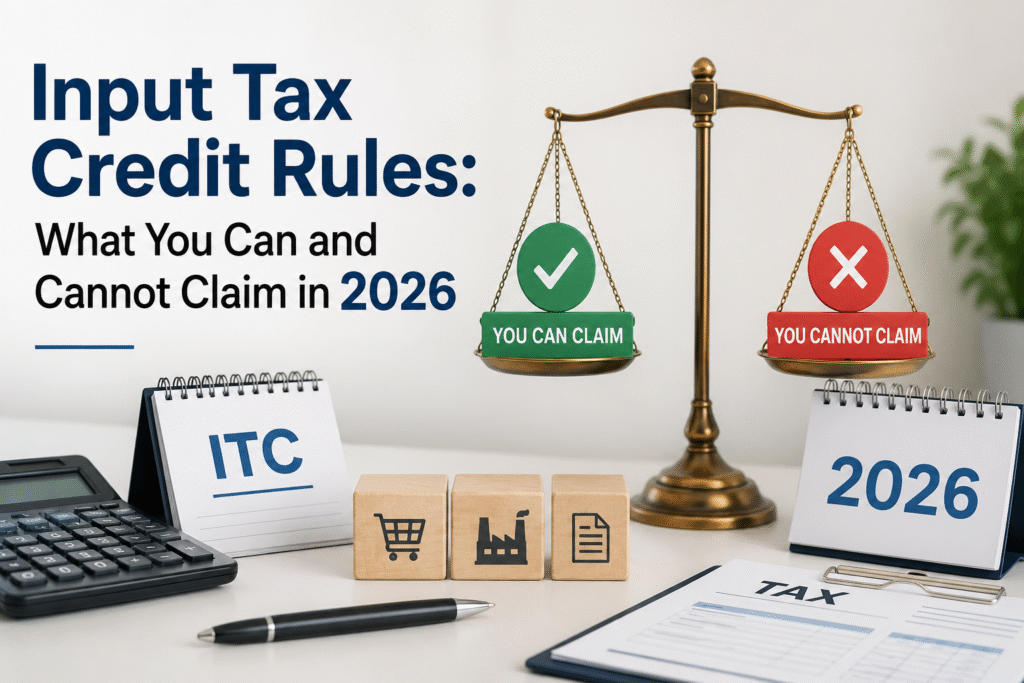
Input Tax Credit (ITC) lets you reduce the GST you owe on sales by the GST you already paid on purchases. The principle is simple — you should only pay tax on the value you add, not on the full amount again.
In 2026, the compliance requirements around ITC are stricter. GSTR-2B is now the absolute ceiling, provisional buffers are gone, and penalties for wrong claims are heavier. Understanding the rules is no longer optional.
Who Can Claim ITC?
Only GST-registered businesses can claim ITC. Along with valid registration, all four conditions below must be met at the same time:
You must hold a valid tax invoice from a GST-registered supplier. The goods or services must have been actually received. The invoice must appear in your GSTR-2B. You must pay the supplier within 180 days of the invoice date — failing which, the claimed ITC must be reversed with interest.
The GSTR-2B Rule You Cannot Ignore
GSTR-2B is no longer just a reference document — it is the absolute ceiling for ITC claims. No ITC can be claimed for any invoice that does not appear in GSTR-2B, and the earlier provisional ITC buffer has been completely eliminated.
If your supplier files GSTR-1 late, the invoice will appear in a later month’s GSTR-2B. You can claim it that month, as long as you are within the November deadline.
Deadline to Claim ITC
ITC for any invoice of a financial year must be claimed by 30 November of the following year, or before filing the annual return GSTR-9, whichever is earlier. After this window, the ITC lapses permanently.
Filing GSTR-9 early before November 30 closes the window immediately. Always reconcile ITC fully before filing the annual return.
What You Can Claim
Raw materials and components used in production, professional fees such as legal, consulting, and audit charges, office rent and utilities, software and cloud subscriptions used for business, capital goods like machinery and computers, and inward supplies on which Reverse Charge Mechanism applies are all eligible — provided the goods or services are used for taxable or zero-rated supplies.
If an expense serves both taxable business and personal or exempt purposes, only the business-use portion qualifies for credit.
What You Cannot Claim: Blocked Credits Under Section 17(5)
Section 17(5) of the CGST Act lists supplies and expenses where ITC cannot be claimed. Blocked credit applies even when supplies are used exclusively for business purposes.
| Category | Blocked | Exception |
|---|---|---|
| Motor vehicles with up to 13 seats | Yes | If used for vehicle supply, passenger transport, or driving school |
| Vessels and aircraft | Yes | If used in transport or aviation training business |
| Food, beverages, outdoor catering | Yes | If legally mandated by any law for employees |
| Beauty treatment, health services | Yes | If it is the core business activity |
| Club and gym memberships | Yes | No exception |
| Works contract for construction | Yes | If used for further works contract supply |
| Construction of immovable property | Yes | Plant and machinery are excluded |
| Goods lost, stolen, or destroyed | Yes | No exception |
| Free gifts and samples | Yes | No exception |
| Purchases from composition dealers | Yes | No exception |
Proportionate Reversal: Mixed-Use Inputs
When inputs are used for both taxable and exempt supplies, or partly for business and personal use, you cannot claim full ITC. GST rules require proportionate reversal under Rule 42 for goods and services and Rule 43 for capital goods.
Reversals are done monthly and reconciled at year-end. All reversals are reported in GSTR-3B Table 4(B)(1).
One firm rule to remember: Section 17(5) has no “predominant use” exception. Even if a company car is used 90% for business, ITC remains blocked.
Penalties for Wrong ITC Claims
Wrongly claiming ineligible ITC results in credit reversal with interest charges ranging from 18 to 24 percent per annum. The GST law also permits penalties up to the tax amount involved or Rs 10,000, whichever is higher.
If ITC is wrongly claimed and utilised, interest at 24 percent per annum applies from the date of the incorrect claim until the date of reversal.
Common Mistakes to Avoid
Claiming ITC on invoices not in GSTR-2B is the most frequent error. Not reversing ITC when a supplier is not paid within 180 days is another. Treating purchases from composition dealers as ITC-eligible, missing the November deadline by filing GSTR-9 early, and ignoring RCM ITC are all costly mistakes that trigger notices.
Frequently Asked Questions:
Q1. Can I claim ITC if my supplier has not paid the GST to the government?
No. ITC can only be claimed once the supplier has deposited the tax. If the invoice does not appear in your GSTR-2B, you cannot claim it regardless of whether you hold a valid invoice.
Q2. What happens if I miss the November 30 deadline for claiming ITC?
After the November 30 window, the ITC lapses permanently. There is no provision for claiming it in subsequent returns.
Q3. Can I claim ITC on a company car purchased for official use?
ITC remains blocked for motor vehicles primarily used for transporting persons with a seating capacity of up to thirteen persons, including company cars for executives. The only exception is if your business is in vehicle supply, passenger transport, or driving school training.
Q4. Is ITC allowed on employee health insurance?
Generally no. Health insurance premiums for employees are blocked under Section 17(5) unless the employer is legally mandated to provide it under a specific law.
Q5. Can I claim ITC on office renovation costs?
No. ITC is not available on works contract services used for construction of immovable property. Office renovation falls under this category and ITC is blocked, though purchase of plant and machinery remains eligible.
Q6. What if I claimed ITC on an ineligible item by mistake?
You must reverse the ITC originally claimed, along with interest at 18% per annum. Once you do pay, you can re-claim the ITC in a later return, but the interest is a permanent cost.
Q7. Is ITC available on RCM (Reverse Charge Mechanism) transactions?
Yes. ITC on RCM inward supplies is available, but it can only be utilised after the tax under RCM has actually been paid in cash. It cannot be used to pay the RCM liability itself.
Q8. Can a composition dealer claim ITC?
A composition taxpayer cannot claim ITC on GST paid on purchases as they pay tax on their quarterly turnover.
Discover more from
Subscribe to get the latest posts sent to your email.


