
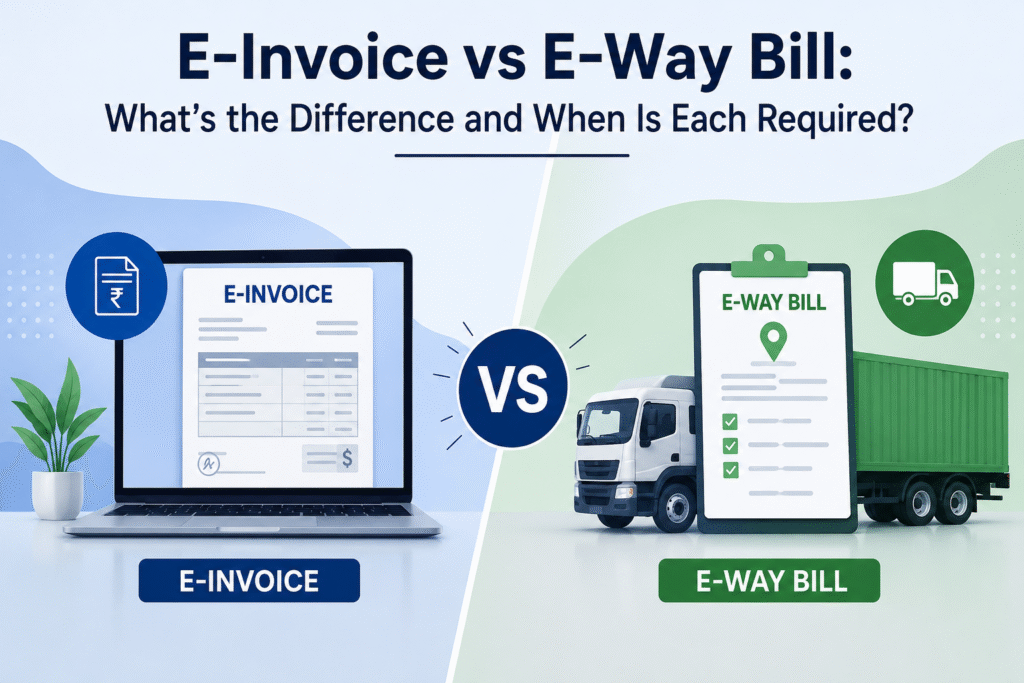
If you run a GST-registered business in India, two compliance documents will come up repeatedly — e-invoice and e-way bill. Many taxpayers use the terms interchangeably, which leads to errors, penalties, and unnecessary confusion. They are separate mandates, serve different purposes, and trigger under different conditions. This guide breaks it all down clearly.
What is an E-Invoice?
An e-invoice is a digitally authenticated B2B tax invoice generated through the Invoice Registration Portal (IRP) operated by the GSTN. When a supplier uploads invoice data, the IRP validates it and returns a unique Invoice Reference Number (IRN) along with a QR code. Only after this process does the document become a valid GST invoice for the buyer to claim Input Tax Credit (ITC).
E-invoicing is about authentication and standardisation of the invoice at the time of its creation. It is a supplier-facing compliance requirement under GST law.
What is an E-Way Bill?
An e-way bill is an electronic permit required for the movement of goods worth more than ₹50,000. It is generated on the NIC e-way bill portal and must accompany the shipment from origin to destination. The transporter, supplier, or recipient can generate it, and it carries a unique e-way bill number (EBN) that tax officers can verify at checkpoints.
E-way bill is about regulating the physical transport of goods. It is a logistics and movement-facing compliance requirement.
| Parameter | E-Invoice | E-Way Bill |
|---|---|---|
| Purpose | Authenticate B2B tax invoices via IRP | Permit movement of goods above ₹50,000 |
| Portal | Invoice Registration Portal (IRP/GSTN) | NIC E-Way Bill Portal (ewaybillgst.gov.in) |
| Trigger | Issue of B2B / B2G / export invoice | Consignment value exceeds ₹50,000 |
| Applicable to | Registered taxpayers above turnover threshold | Suppliers, transporters, or recipients |
| B2C applicability | Not required (except specific exports) | Required if goods value exceeds threshold |
| Validity | No expiry; permanent once IRN is generated | 1 day per 200 km (extendable) |
| Cancellation window | Within 24 hours of generation | Within 24 hours or before verification |
| Auto-population | Auto-populates GSTR-1 and GSTR-2A | No direct GSTR auto-population |
| Key output | IRN + signed QR code on invoice | E-way bill number (EBN) + vehicle details |
When Is E-Invoicing Required?
As of FY 2024–25, e-invoicing is mandatory for all GST-registered businesses with an aggregate annual turnover exceeding ₹5 crore in any preceding financial year. The government has progressively lowered this threshold from ₹500 crore in 2020 to the present limit, and further reduction is widely anticipated.
E-invoicing applies to tax invoices (B2B and B2G), credit notes, debit notes, and export invoices — when issued by a notified taxpayer.
Exemptions include insurance companies, banking and financial institutions, goods transport agencies, passenger transport services, multiplex cinema halls, and SEZ units for certain document categories.
When Is an E-Way Bill Required?
An e-way bill is required whenever goods taxable under GST are transported and the consignment value exceeds ₹50,000. This applies regardless of whether the movement is for supply, return, or job work. The distance covered does not matter; only the value and taxability of the goods do.
An e-way bill is not required for goods transported by non-motorised conveyance, movement within a state for less than 50 km in certain states, specific exempt goods listed under Annexure to Rule 138 such as fresh milk, curd, natural honey, salt, and unbranded atta, and goods transported by railways where a railway receipt is available.
Some states have set their own thresholds for intra-state movement, so businesses must verify state-specific rules separately.
Can Both Be Required for the Same Transaction?
Yes, and this is one of the most common points of confusion. A single B2B sale of goods can require both an e-invoice and an e-way bill simultaneously.
The e-invoice is generated first — before or at the time of raising the invoice. Once the IRN is generated, the supplier or transporter can then generate the e-way bill using the same invoice data. Many ERP systems and IRP portals now allow generating both from a single interface.
If goods are being moved but the value is below ₹50,000, an e-way bill is not needed — but if the turnover threshold for e-invoicing is met, the e-invoice is still required. Conversely, B2C transactions do not need e-invoicing but may need an e-way bill.
Consequences of Non-Compliance
For e-invoicing, an invoice without a valid IRN is not treated as a tax invoice under GST law. The buyer cannot claim ITC on such an invoice, and the supplier may face a penalty of ₹10,000 per invoice or an amount equivalent to the tax evaded, whichever is higher.
For e-way bill, goods transported without a valid e-way bill are liable to be detained or seized. The penalty is ₹10,000 or the tax amount payable on the goods, whichever is higher. The conveyance carrying the goods can also be detained pending resolution.
Frequently Asked Questions
Q1. Can I generate an e-way bill without generating an e-invoice first?
Yes, if e-invoicing does not apply to your business — for example, turnover below ₹5 crore or an exempted sector — you can generate an e-way bill directly using invoice details on the NIC portal. However, if e-invoicing is mandatory for you, the e-invoice must be generated first and the IRN can then be used to generate the e-way bill.
Q2.Does e-invoicing automatically generate an e-way bill?
No, not automatically. When you generate an e-invoice, you have the option to simultaneously fill in Part B of the e-way bill with vehicle and transporter details to get both generated together. But the e-way bill is not created unless you explicitly provide those transport details. Many businesses complete Part A via the IRP and add Part B later when transport is confirmed.
Q3.Is an e-way bill required for services?
No. The e-way bill requirement applies strictly to the movement of goods. Service invoices do not trigger an e-way bill obligation, regardless of the value.
Q4.What if I cancel an e-invoice — does the e-way bill get cancelled too?
No. They are independent. Cancelling an e-invoice within 24 hours does not automatically cancel the e-way bill. You must cancel both separately. If the e-way bill has already been verified at a checkpoint, it cannot be cancelled at all.
Q5.My business is below the e-invoicing threshold. Do I still need to comply with anything?
Yes. You are still required to generate e-way bills for any goods movement above ₹50,000 in value. E-invoicing is a separate mandate and threshold-based; e-way bills apply to all registered and unregistered persons moving taxable goods above the value limit.
Q6.Can the recipient generate an e-way bill?
Yes. The e-way bill can be generated by the supplier, transporter, or recipient — whoever initiates the movement. However, only the generator or the transporter can update Part B with vehicle details. The e-invoice, by contrast, can only be generated by the registered supplier on whose behalf the invoice is being raised.
Final Word
E-invoice and e-way bill are complementary, not interchangeable. One governs the authenticity of a transaction at the billing stage; the other governs the legality of movement at the logistics stage. A B2B business moving taxable goods of high value will typically need both. Treating them as separate checklists — rather than one combined process — is the clearest way to stay compliant and avoid costly penalties.
Discover more from
Subscribe to get the latest posts sent to your email.


