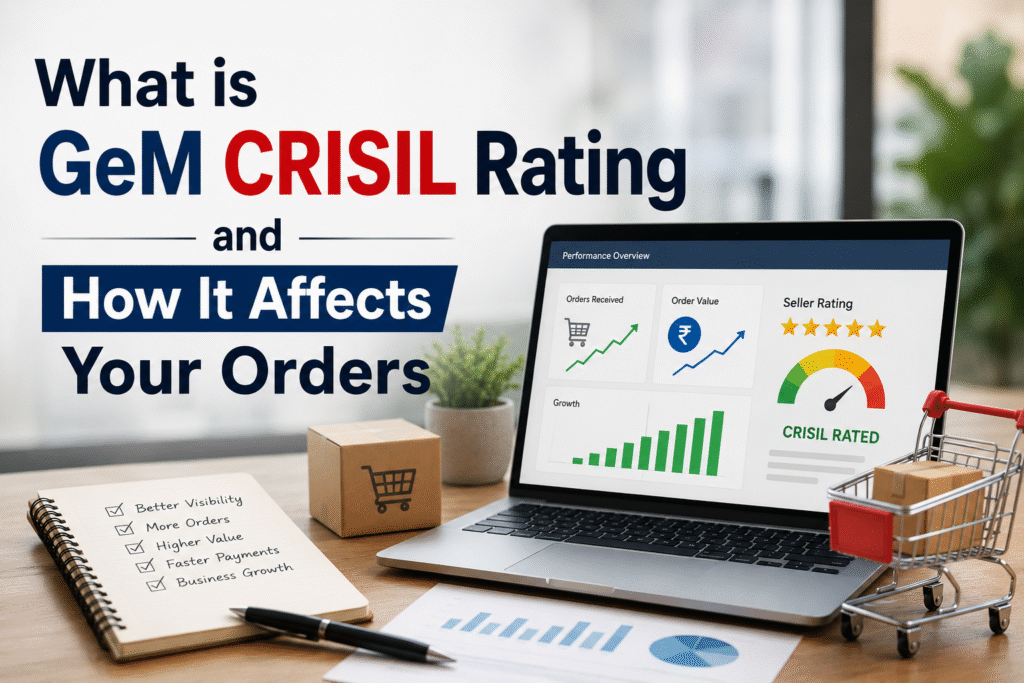
What is GeM CRISIL Rating?
GeM has partnered with CRISIL — India’s leading credit rating agency — to independently assess sellers on the platform. It is not a buyer review. It is a formal financial credibility score assigned after evaluating your business documents.
What CRISIL looks at:
- Annual turnover and profitability
- Years in business (vintage)
- Debt levels and repayment history
- GST compliance and audited financials
Example: A seller with 5 years of operations, clean GST records, and a turnover of Rs. 50 lakh will score better than a 1-year-old business with unaudited books — even if both sell the same product.
Why Did GeM Introduce This?
GeM buyers have faced vendor defaults in the past — sellers who win orders but fail to deliver. The CRISIL rating was introduced to give buyers an independent, data-backed way to assess seller risk before placing an order.
It moves procurement beyond price comparison into trust-based selection.
How is the Rating Calculated?
Sellers submit audited financial statements and business documents to CRISIL. The agency evaluates them and issues a rating band.
| Rating Band | Meaning | Buyer Confidence | Order Impact |
|---|---|---|---|
| CR1 / CR2 | Highest financial strength | Very High | Preferred in bids; eligible for high-value orders |
| CR3 / CR4 | Adequate financial strength | Moderate | Competitive, especially on price |
| CR5 / CR6 | Modest strength | Lower | Scrutinised on large orders |
| Not Rated | No assessment done | Unverified | Disadvantaged vs rated sellers |
How Does It Affect Your Orders?
1. Search Visibility
GeM’s algorithm favours credible sellers. A rated seller appears higher in buyer searches compared to an unrated one with a similar product.
Example: Two sellers offer the same office chair at Rs. 4,500. One is CR2 rated, the other is unrated. The rated seller appears first — and gets more clicks.
2. Buyer Trust in Direct Purchase
Government buyers are accountable for every rupee they spend. A CRISIL rating gives them a documented reason to choose you over a cheaper but unverified competitor.
Example: A PSU buyer shortlists three vendors. Two are unrated. One has a CR3 rating. The rated seller wins the order — not on price, but on credibility.
3. Eligibility for High-Value Tenders
Many tenders above a certain value require proof of financial capacity. A strong CRISIL rating serves as that proof without you needing to submit additional documents every time.
4. Faster Payment Processing
Buyers release payments faster when they trust the seller. A verified financial standing reduces hesitation at the payment stage.
5. Tiebreaker in L1 Bidding
When two sellers quote the same or near-identical price, the buyer uses discretion. A rated seller wins that tiebreak almost every time.
Who Should Get Rated?
Get rated if you are:
- Selling in competitive categories like IT hardware, furniture, or office supplies
- Targeting orders above Rs. 25,000
- Planning to participate in bids and reverse auctions
- An MSME looking to build long-term credibility on GeM
Even a CR4 rating is better than no rating at all.
How to Get Your GeM CRISIL Rating
- Log in to your GeM seller dashboard
- Navigate to the rating or profile credibility section
- Initiate the CRISIL assessment request
- Upload audited financials, GST returns, and business documents
- CRISIL evaluates and publishes your rating within 2 to 4 weeks
Renew it every year with updated financials to keep it active and accurate.
Common Mistakes to Avoid
- Submitting unaudited or outdated financial statements — this pulls your rating down
- Skipping the rating assuming your turnover is too low — even small businesses get rated
- Not renewing on time — an expired rating is treated the same as no rating by buyers
- Assuming price alone will win orders — in government procurement, credibility closes deals
Frequently Asked Questions
Q1. Is the CRISIL rating mandatory on GeM?
Not officially. But in high-competition categories, rated sellers win a disproportionate share of orders. Skipping it puts you at a structural disadvantage against rated competitors.
Q2. How long does the CRISIL rating process take?
Typically 2 to 4 weeks after you submit complete documents. Delays usually happen when documents are incomplete, unaudited, or mismatched with GST records.
Q3. Does a low rating hurt more than having no rating?
No. Any rating is better than being unrated. Even a CR5 tells the buyer you have been assessed and verified as a legitimate business — which unrated sellers cannot claim.
Q4. Can a new business with low turnover apply for CRISIL rating?
Yes. CRISIL’s methodology is designed to assess businesses at different stages. A newer business receives a rating that reflects its scale fairly — not a rejection based on size alone.
Q5. How often should I renew my CRISIL rating on GeM?
Every year. Always renew with the latest audited financials. If your revenue has grown since the last assessment, renewing quickly works strongly in your favour.
Q6. Will buyers see my CRISIL rating automatically?
Yes. Once issued, it appears directly on your GeM seller profile. Every buyer who views your listing or compares vendors in a bid can see it without any extra step.
Q7. What documents are needed to get a CRISIL rating?
You typically need audited financial statements for the last 1 to 3 years, GST returns, business registration proof, and bank statements. A CA-certified balance sheet strengthens the assessment.
Q8. Can the CRISIL rating improve over time?
Yes. As your turnover grows, your debt reduces, and your compliance record strengthens, your rating improves at renewal. Sellers who started at CR4 have moved to CR2 within two renewal cycles.
Discover more from
Subscribe to get the latest posts sent to your email.