
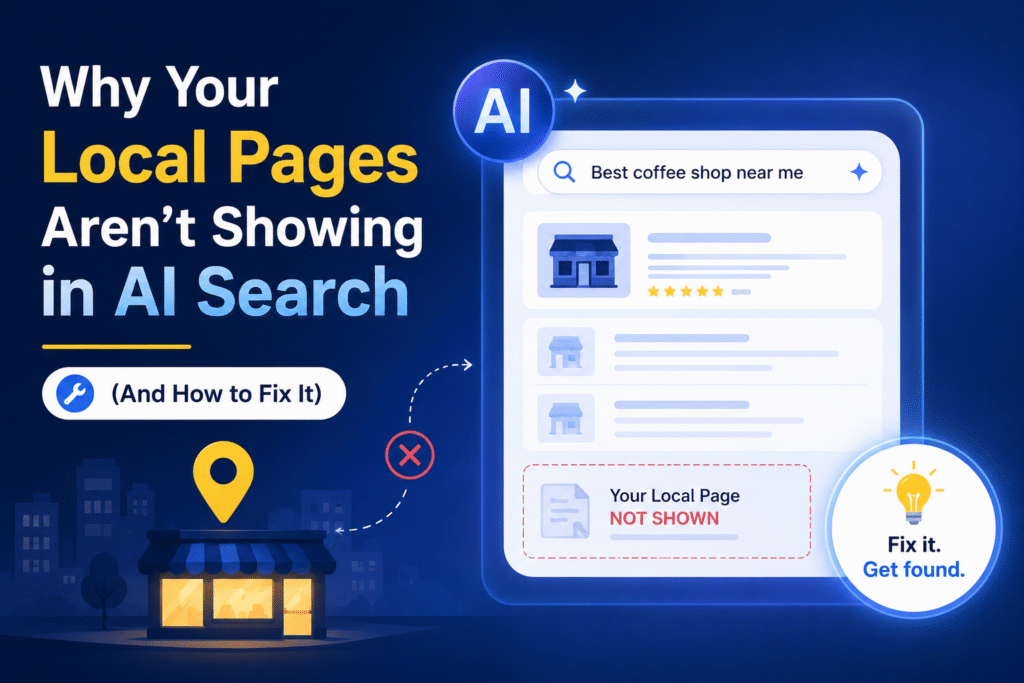
Search has changed. When someone types “best dentist near me” or “HVAC repair open Sunday in Dallas,” they no longer get a list of blue links. They get an AI-generated answer — a confident paragraph naming specific businesses, pulling from reviews, structured data, and location pages that AI systems trust.
If your business is not in that answer, you are invisible to a growing slice of your audience. The question is not whether AI search matters. It already does. The question is why your local pages are being skipped — and what you can do about it today.
How AI Search Discovers Local Businesses?
AI-powered search engines like Google’s AI Overviews, ChatGPT with browsing, and Perplexity do not crawl the web the same way traditional search does. They look for signals that confirm a business is real, relevant, and trustworthy for a specific location.
Those signals come from three places: your website’s location pages, your business listings across the web, and the reviews tied to those listings. When all three align and speak the same language, AI systems feel confident recommending your business. When they don’t, your pages get passed over — even if you rank well in traditional search.
The Most Common Reasons Your Local Pages Are Getting Ignored
Your location pages are thin and templated.
Many businesses create location pages by copying the same content and swapping out the city name. AI systems recognize this pattern and treat templated pages as low-value. A page that says “We offer plumbing services in Houston. Contact our Houston team today.” tells an AI almost nothing useful about what makes that location relevant or trustworthy.
Your NAP data is inconsistent across the web.
NAP stands for Name, Address, and Phone number. If your business appears as “BizWithTech LLC” on your website, “Biz With Tech” on Yelp, and “BizWithTech Inc.” on Google Business Profile, AI systems flag that inconsistency. It creates ambiguity about whether these are the same business — and ambiguity kills citation confidence.
You are missing or misusing structured data.
Schema markup is the language AI uses to read your pages quickly. Without LocalBusiness schema that includes your address, hours, service area, and geo-coordinates, your page is just unstructured text. AI systems have to guess what your page is about, and they often don’t bother.
Your Google Business Profile is incomplete or stale.
An incomplete profile — missing hours, no photos, no service descriptions, no recent reviews — signals to AI that this location may not be actively operating. AI-powered answers prioritize businesses that look alive and active.
Your reviews are sparse or unresponded to.
AI systems treat reviews as third-party validation. A location with 4 reviews from three years ago competes poorly against a competitor with 80 recent reviews and consistent owner responses. Review velocity and recency both matter.
What AI Search Actually Wants From a Local Page?
| Signal | What AI Looks For | Common Mistake |
|---|---|---|
| Page Content | Genuine local detail — landmarks, neighborhoods, staff | Copy-paste template with city name swapped |
| Schema Markup | LocalBusiness with address, hours, geo, services | No schema or incomplete schema |
| NAP Consistency | Exact match across site, GBP, and directories | Small variations across platforms |
| Google Business Profile | Complete, active, regularly updated | Missing categories, no photos, stale info |
| Reviews | Recent, numerous, owner-responded | Old reviews, zero responses |
| Internal Linking | Location pages linked from homepage and service pages | Location pages orphaned from site structure |
| Citations | Consistent listings on Yelp, Apple Maps, Bing Places | Listed on two directories with inconsistent data |
How to Fix Your Local Pages for AI Visibility?
Audit every location page for real local content.
Read each page as if you know nothing about the business. Does it explain what services are available at that specific location? Does it mention the surrounding area, local landmarks, or neighborhood context? Does it answer questions a local customer would actually have? If not, the page needs a full rewrite — not a tweak.
Implement LocalBusiness schema on every location page.
At minimum, include: business name, address, phone number, hours of operation, geographic coordinates, service area, and URL. If you offer specific services, use the
hasOfferCatalogproperty to list them. Google’s Structured Data Markup Helper is a practical starting point.
Run a NAP audit across every directory.
Pull your listing from Google Business Profile, Yelp, Bing Places, Apple Maps, Facebook, and any industry-specific directories. Every one should show the exact same name, address, and phone number. Tools like BrightLocal or Whitespark can find inconsistencies and help you correct them systematically.
Treat your Google Business Profile as a live document.
Update it every two to four weeks. Add photos from the location. Post updates about offers, hours changes, or new services. Answer every review. Fill in every available field including business description, service list, and product catalog where applicable.
Build a review generation system.
Ask for reviews at the right moment — right after a positive service interaction, not weeks later. Send a direct link to your Google review page to make it frictionless. Respond to every review within 48 hours. Aim for a steady drip of new reviews rather than a one-time burst campaign followed by silence.
Fix your internal linking structure.
Location pages buried three or four clicks from the homepage rarely get crawled or weighted heavily. Link to each location page from your main navigation, your homepage footer, and any relevant service pages. A clear internal link structure signals to AI that these pages matter.
Traditional SEO vs. AI SEO for Local: The Real Difference
Traditional local SEO was about getting to page one. AI search is about being cited as the answer. That is a meaningful shift. AI systems are not ranking your page — they are deciding whether to reference your business as a credible response to a user’s question.
The old playbook of building backlinks and targeting keywords, while still useful, is no longer enough on its own. AI systems reward entities — businesses that are clearly defined, consistently described across the web, and backed by signals from multiple independent sources like reviews, listings, and third-party mentions.
Traditional SEO asks “how do I rank?” AI SEO asks “how do I become the obvious answer?”
A Fix Timeline for Multi-Location Businesses
If you run more than one location, the scale of this work can feel overwhelming. A realistic sequence: start week one with a full NAP audit and fix inconsistencies across Google, Yelp, and Bing. In weeks two and three, rewrite your highest-traffic location pages with genuine local content and add LocalBusiness schema. In week four, bring every Google Business Profile to completion and set up a review request workflow. From month two onward, focus on review velocity, regular GBP updates, and expanding your citation footprint to additional directories.
Consistency over time matters more than a one-time sprint.
Frequently Asked Questions
Q1. Does traditional SEO ranking still matter if I want AI visibility?
Yes, but it is no longer sufficient on its own. AI systems do consider organic ranking as one trust signal, but they weight entity clarity, structured data, and review signals heavily. A page ranking position five with strong schema and consistent citations may get cited by AI more than a page ranking position one with thin content.
Q2. How many location pages do I need for a multi-location business?
One dedicated page per physical location at minimum. If you serve multiple cities from a single location, service-area pages work — but they must contain genuinely unique and useful content for each area, not duplicated text with city names swapped.
Q3. How long does it take for AI search to recognize my fixed local pages?
There is no fixed timeline. Generally, if you fix structured data and NAP issues, improvements can appear within four to eight weeks as AI systems re-crawl your pages and updated listings propagate. Review improvements take longer since review velocity builds over months.
Q4. Do I need to be on every business directory?
No. Prioritize the major platforms: Google Business Profile, Yelp, Bing Places, Apple Maps, and Facebook. Then add industry-specific directories relevant to your category. Quantity without accuracy does more harm than good.
Q5. Can AI search hurt my local visibility even if my traditional rankings are fine?
Yes. As more searches return AI-generated answers at the top of the page, businesses not cited in those answers see reduced visibility even if their organic ranking has not changed. AI search and traditional search are now two separate visibility channels that both require attention.
Q6. What is the single most important fix for a business just starting out?
Complete and verify your Google Business Profile. It is the one signal that feeds into Google’s AI Overviews, Maps, and traditional search simultaneously. No other single action has as broad an impact across as many AI-driven surfaces.
Discover more from
Subscribe to get the latest posts sent to your email.