
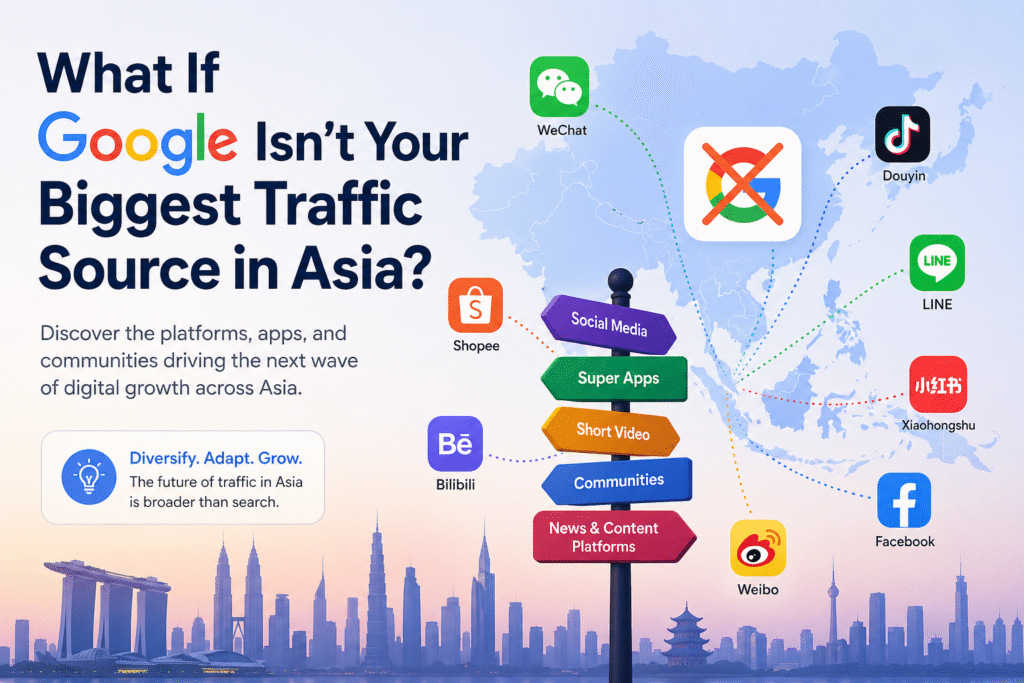
Let’s Start With a Simple Question
Imagine you open a shop in a new city. You put up a big sign on Main Street. But what if most locals never walk down Main Street? What if they shop at a different market, in a different neighborhood, that you did not even know existed?
That is exactly what happens when brands enter Asia with a Google-only strategy.
Google Is Not the Only Game in Town
Think of search engines like TV channels. In the US, everyone watches the same two or three channels. In Asia, every country has its own local favorite — and sometimes that local channel beats the international one.
Here is a simple breakdown:
| Country | It’s Like… | Who Competes With Google |
|---|---|---|
| Japan | Two equally popular TV channels | Bing holds 31% of searches |
| South Korea | Local channel beats international | Naver rivals Google at 43% share |
| China | International channels are banned | Baidu runs the show |
| Vietnam | One local channel sneaking up | CocCoc holds 5% and growing |
| India | One big channel, but new ones emerging | LLM tools spreading through telecom deals |
So if you are running ads or SEO only on Google, you are advertising on one channel while a huge chunk of your audience watches another.
A Real-World Example: The Japan Problem
Say you sell productivity software and you want customers in Japan.
You run Google Ads, optimize your website for Google, and wait. Results are okay — but not great. You wonder why.
Here is what you missed. Nearly one in three Japanese users searches on Bing, not Google. A lot of Japanese office workers use Windows computers with Microsoft Edge as the default browser. Bing comes pre-set. They never bother changing it. They just search.
Your competitor, who figured this out, is running Bing Ads in Japan. They are showing up for the same keywords you are targeting — but on the platform your audience actually uses. You are invisible to that audience.
The fix is not complicated. It just requires knowing the map before you start driving.
South Korea Is a Completely Different Situation
In South Korea, there is a platform called Naver. Think of it less like Google and more like a combination of Google, Reddit, and a shopping mall — all in one place.
When a Korean user wants to research a product, they do not just type a query and scan links. They go to Naver, read blog posts written inside Naver’s own blogging platform, check community discussions, look at shopping listings, and make a decision — all without leaving Naver.
If your brand has no presence inside that ecosystem, you simply do not exist for that user. It does not matter how well you rank on Google.
A simple analogy: imagine a customer walks into a mall, browses every shop inside, and buys something. Your store is not in that mall. It is across the street. They never even looked your way.
Now Add AI Tools Into the Mix
Here is where things get even more interesting — and more urgent.
You have probably used ChatGPT or Google’s Gemini to ask a question and get a direct answer. That is called an LLM, or large language model. Instead of showing you ten links, it reads the internet and gives you one summarized answer.
Now imagine 500 million people in India getting free access to Gemini through their phone plan — bundled automatically, the way data or SMS is bundled. No download required. It just appears. Reliance Jio did exactly that.
Airtel did the same with Perplexity for around 360 million users.
These people are not “switching to AI search.” They are simply using what came with their phone plan. And when they ask a question, they get one answer — not ten links. Your brand either gets mentioned in that answer or it does not.
How LLMs Decide Who Gets Mentioned?
Think of an LLM like a very well-read assistant who has read millions of articles. When someone asks it a question, it picks the clearest, most trustworthy explanation it has seen and presents it.
It does not care about how many backlinks your site has. It cares about how clearly you explain things.
For example, if someone asks “what is the best project management tool for small teams?” — the LLM will cite whichever source explained the answer most clearly, with real comparisons, simple structure, and credible detail. If your content is vague, keyword-stuffed, or hard to scan, it gets skipped.
Content that gets cited by LLMs tends to have clear definitions, direct comparisons, specific examples, and honest answers — exactly what BizWithTech is doing right now.
Super-Apps: When the Whole Journey Happens Inside One App
In Japan, LINE is not just a messaging app. People use it to follow brands, receive offers, contact customer support, and make purchases. Many Japanese TV commercials do not say “visit our website.” They say “follow us on LINE.”
In South Korea, KakaoTalk works the same way. Discovery, research, and purchase all happen inside one app. The user never opens a browser.
So even if your Google SEO is perfect, if a Korean user discovers, researches, and buys inside KakaoTalk — and your brand has no presence there — you lost the sale before the game even started.
What Should You Actually Do?
Start by checking the real search share data for the specific country you are targeting — not the global average. Then ask three questions.
Who is searching, and on which platform? What does my content look like to an AI tool trying to summarize it? And where does my customer actually spend time online — is it a browser, an app, or a messaging platform?
Once you know the answers, the actions become clear. Add Bing to your Japan paid strategy. Build a Naver presence for South Korea. Structure your content so LLMs can extract and cite it easily. Show up where your audience actually is.
Frequently Asked Questions
Q1. Is Google useless in Asia?
Not at all. Google still leads in most of Southeast Asia, India, and Australia. The point is that Google-only thinking creates blind spots in markets like Japan and South Korea where local or alternative platforms hold serious share.
Q1. What is Naver in simple terms?
Naver is South Korea’s version of Google, but built more like a content platform. Users read, shop, and research all within Naver itself. It has its own blogging system, news, and community sections. Ranking on Google does not help you inside Naver.
Q2. How is LLM traffic different from search traffic?
Search gives users ten options. An LLM gives one summarized answer with one or two sources. So instead of competing for position one through ten, you are competing to be the single source that gets mentioned. Structure and clarity matter more than keyword volume.
Q3. Can a small business realistically target multiple platforms?
Yes, with a focused approach. You do not need to be everywhere at once. Pick the one or two markets most important to your growth, identify which platforms matter there, and start small. A Bing Ads campaign in Japan, for example, is not complicated — it just requires knowing it matters.
Q4. How do I know if LLMs are already sending me traffic?
Check your referral traffic in Google Analytics for sources like perplexity.ai or chatgpt.com. Also watch your direct traffic trend — some LLM-driven visits do not pass referral data and appear as direct. Dedicated AI visibility tools are also starting to emerge for this.
Q5. What is the single easiest first step?
Pull up search engine market share data for your target Asian country. If you see any platform above 10% that is not Google, that is your first blind spot to investigate.
Discover more from
Subscribe to get the latest posts sent to your email.