
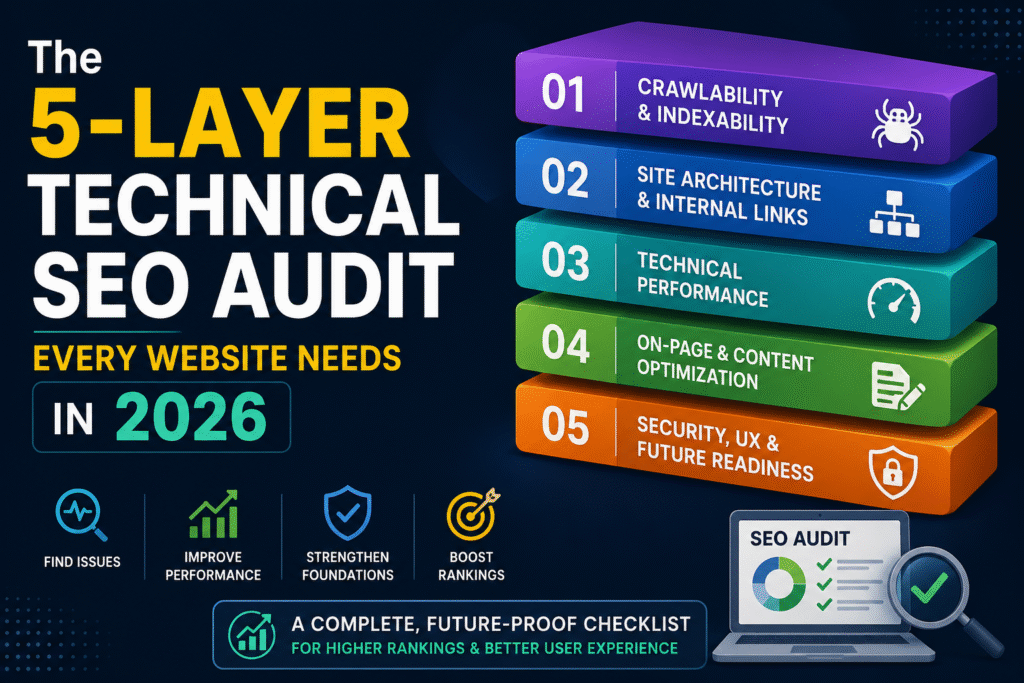
The standard technical SEO audit was built for one consumer: Googlebot. In 2026, that is no longer enough. Your website now serves over a dozen non-human visitors — AI crawlers, agentic browsers, and LLM-powered search systems that operate on entirely different rules. If your audit checklist has not changed in the last two years, you are optimizing for a search landscape that no longer exists.
Here is what the modern technical SEO audit looks like, layer by layer.
Layer 1: AI Crawler Access
Most robots.txt files were written with Googlebot and Bingbot in mind. That logic does not hold in 2026. AI crawlers like GPTBot, ClaudeBot, PerplexityBot, and Google-Extended each serve a different purpose, and treating them as a single group is a costly mistake.
According to Cloudflare’s Q1 2026 network analysis, 30.6% of all web traffic now comes from bots, with AI crawlers making up a growing share. More importantly, not all of them give back what they take. OpenAI’s crawl-to-referral ratio sits at 1,300:1. Anthropic’s ClaudeBot crawls over 20,000 pages for every single referral it generates. Meta sends zero referrals.
The audit question is not just “are AI crawlers allowed?” It is “have you made a conscious, per-crawler decision based on what each one returns?” Blanket allow or blanket block both leave value on the table. One crawler that demands special attention is Google-Agent, added to Google’s official fetcher list in March 2026. Unlike traditional crawlers, it ignores robots.txt entirely because Google treats it as a user proxy rather than an autonomous bot.
Layer 2: JavaScript Rendering
Googlebot renders JavaScript using headless Chromium. AI crawlers do not.
GPTBot, ClaudeBot, PerplexityBot, and CCBot all fetch static HTML only. If your product descriptions, pricing, or key content live inside client-side JavaScript, those crawlers are receiving a blank page with a link to a JavaScript bundle. That content does not exist for them.
| Crawler | Renders JavaScript |
|---|---|
| Googlebot | Yes |
| AppleBot | Yes |
| GPTBot (OpenAI) | No |
| ClaudeBot (Anthropic) | No |
| PerplexityBot | No |
| CCBot (Common Crawl) | No |
The fix is straightforward. Running curl -s [URL] on your critical pages and searching the output for key content tells you what AI crawlers actually see. If your product name, price, or main service description is absent from that output, it is invisible to the models training on your content and powering AI search results. Server-side rendering (SSR) or static site generation (SSG) solves this for React, Vue, and Angular applications through Next.js, Nuxt, and Angular Universal respectively.
Layer 3: Structured Data for AI
Structured data has been part of SEO audits for years. The evaluation criteria, however, need a serious update. The question has shifted from “does this page have schema?” to “does this markup help AI systems understand and cite this content?”
Microsoft’s Bing product team confirmed in early 2025 that schema markup helps LLMs understand content for Copilot. Research published by Princeton, Georgia Tech, and the Allen Institute found that adding statistics to content improved AI visibility by 41%. Yext’s analysis found that data-rich websites earn 4.3x more AI citations than directory-style listings.
What to audit in this layer goes beyond checking for presence. JSON-LD implementation is preferred over Microdata and RDFa for AI parsing. Schema types need to go deeper than Organization and Article — FAQPage, HowTo, and Person schemas with complete property values matter. Entity relationships, specifically sameAs connections linking your content to known entities on LinkedIn, Wikipedia, or Crunchbase, are what allow AI systems to confidently attribute content to your brand rather than guessing. A skeleton schema with only name and URL checks a box but provides no real signal.
Layer 4: Semantic HTML and the Accessibility Tree
This is the layer most technical SEOs are not auditing yet, and it may be the most important one for the next generation of AI-driven traffic.
Agentic browsers — ChatGPT Atlas, Chrome with auto browse, Perplexity Comet — do not parse pages the way Googlebot does. They read the accessibility tree, a parallel representation of your page that strips away visual styling and keeps only semantic structure: headings, links, buttons, form fields, and the relationships between them. Microsoft’s Playwright MCP, the standard tool for connecting AI models to browser automation, uses accessibility snapshots rather than raw HTML or screenshots because they are more compact and semantically meaningful for LLMs.
OpenAI has confirmed that ChatGPT uses ARIA tags to interpret page structure when browsing. What your HTML communicates structurally is now what AI agents act on. A div styled to look like a button does not appear as a button in the accessibility tree. An image without alt text means nothing. A heading hierarchy that jumps from H1 to H4 creates broken navigation that both screen readers and AI agents struggle to process.
The WebAIM Million 2026 report found the average web page now carries 56.1 accessibility errors, up 10.1% from the previous year. Pages with ARIA present averaged 59.1 errors — more than pages without it — because incorrectly applied ARIA overrides correct browser defaults with wrong information. The right sequence is to start with proper semantic HTML and add ARIA only when native elements are insufficient.
Web accessibility and AI agent compatibility are now the same discipline.
Layer 5: AI Discoverability Signals
The final layer covers signals that do not fit neatly into traditional audit categories but directly determine whether AI systems discover, cite, and recommend your content.
llms.txt
is a simple markdown file placed at the root of your domain to help AI agents understand your site’s purpose and key content. Its actual impact on AI citations remains unproven at scale, but LLMs consistently recommend it, which means AI-powered audit tools and consultants will flag its absence. It costs nothing to create.
AI crawler analytics
should be part of every technical SEO reporting setup. Cloudflare’s AI Audit dashboard shows which AI crawlers are visiting, how frequently, and which pages they are hitting. Without this data, you cannot make informed robots.txt decisions or understand your AI search exposure.
Entity definition
is foundational. Organization schema should include name, URL, logo, founding date, and sameAs links to verified profiles. Person schema for key authors or executives should connect them to the organization. AI systems resolve your identity as a distinct entity before they cite you confidently. Building this into your site from the start saves significant correction work later.
Content position
matters more than most SEOs realize. An analysis of 98,000 ChatGPT citation rows found that 44.2% of all AI citations come from the top 30% of a page. The bottom 10% earns only 2.4–4.4% of citations. Stanford researchers have documented this as the “lost in the middle” phenomenon — LLMs consistently underweight information placed in the middle of long documents. Audit your key pages with this in mind. Your most important claims and data points belong near the top.
Content extractability
is the final check. Pull any key claim from your page and read it in isolation. If it requires surrounding paragraphs to make sense — if it relies on “this,” “it,” or “as mentioned above” — it is not citable by AI retrieval systems. Self-contained sentences with explicit entity references are what AI systems can confidently extract and quote.
The Full Audit Checklist at a Glance
| Layer | What to Check | Tool or Method |
|---|---|---|
| AI Crawler Access | Per-crawler robots.txt rules | Manual robots.txt review |
| JavaScript Rendering | Critical content in static HTML | curl, View Source |
| Structured Data | Complete, connected JSON-LD | Schema validator, Rich Results Test |
| Semantic HTML | Heading hierarchy, semantic elements | axe DevTools, Lighthouse |
| Accessibility Tree | What agents actually see | Playwright MCP, screen reader |
| AI Discoverability | Bot traffic, entity markup, content position | Cloudflare, server logs, schema tools |
Why Technical SEOs Own This
None of this is technically Google SEO. Robots.txt rules for AI crawlers do not move keyword rankings. Accessibility tree optimization does not change position reports. But every skill required to execute this audit — crawl management, structured data, semantic HTML, JavaScript rendering, log analysis — is already in the technical SEO toolkit. The consumer this work serves has changed. The foundation it builds on has not.
The websites that earn AI citations, that work correctly when agentic browsers visit them, that appear when someone asks ChatGPT or Perplexity for a recommendation, will be the ones whose technical structure made their content accessible to machines. That is a technical SEO problem with a technical SEO solution.
Frequently Asked Questions
Q1. Does blocking AI crawlers affect Google rankings?
No. Robots.txt rules for GPTBot, ClaudeBot, or PerplexityBot have no effect on Googlebot’s crawling or your Google search rankings. They are entirely separate systems. Blocking training crawlers will reduce the likelihood of your content appearing in AI-generated answers on platforms like ChatGPT or Perplexity, but it will not impact traditional search performance.
Q2. Is server-side rendering necessary if I already rank well on Google?
For Google rankings, client-side rendering has become less of an issue since Googlebot renders JavaScript. But if AI search visibility matters to your business — and in 2026 it increasingly does — SSR is effectively required. GPTBot, ClaudeBot, and PerplexityBot cannot render JavaScript, meaning client-side content is invisible to the models powering those systems.
Q3. How is the accessibility tree different from the DOM?
The DOM is the full rendered structure of your page after JavaScript has executed. The accessibility tree is a filtered, semantic version of that structure — it contains only meaningful elements like headings, links, buttons, and form fields. AI agentic browsers use the accessibility tree because it is faster to process and more semantically meaningful than either raw HTML or screenshots.
Q4. Does llms.txt actually improve AI search rankings?
There is no peer-reviewed evidence yet that llms.txt directly improves AI citation rates. It is a low-effort signal that tells AI agents about your site’s structure and purpose. Its main practical value right now is that AI-powered audit tools consistently flag its absence, and LLMs recommend it, which makes it a visible gap for clients and stakeholders.
Q5. What is the fastest way to check if AI crawlers can see my content?
Run curl -s [your URL] in a terminal and search the output for your main content — product names, prices, key claims. If it is not in the curl response, it is not visible to GPTBot, ClaudeBot, or PerplexityBot. This takes under two minutes and gives you a direct answer without needing any third-party tool.
Q6. How often should this AI-layer audit be repeated?
At minimum, once per quarter. The AI crawler landscape is changing rapidly — new agents are being launched, crawl policies are being updated, and citation behavior is being studied in real time. A static audit from six months ago may already be missing significant new signals, particularly around agentic browsing and entity resolution.
Discover more from
Subscribe to get the latest posts sent to your email.