
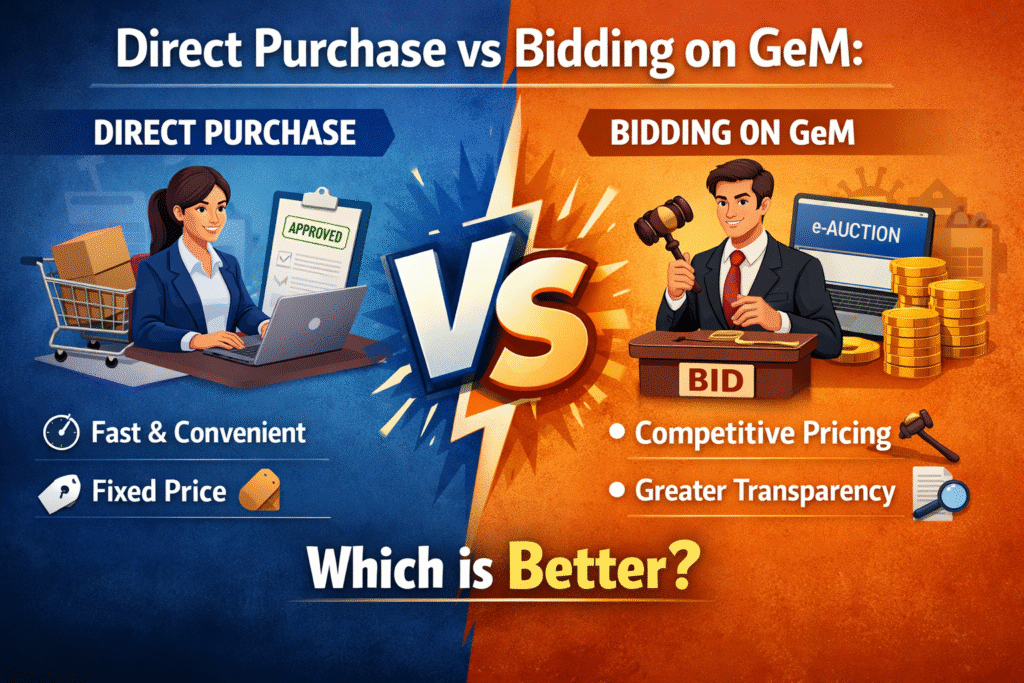
The Government eMarketplace (GeM) portal has changed how government departments buy products and services. For sellers, understanding the two main routes through which orders arrive — direct purchase and bidding — is not just helpful, it is essential for building a sustainable GeM business.
What is Direct Purchase on GeM?
Direct purchase is the simplest route available on GeM. A government buyer searches the catalogue, compares available options, and places an order directly without floating any tender or inviting competitive bids. This typically applies when the order value is below a defined threshold — currently up to Rs 25,000 per order for goods in many categories, though GeM revises these limits periodically.
The buyer has complete discretion to choose any seller based on price, ratings, delivery speed, and OEM authorisation. No prior notification is sent to sellers. The order simply lands in your dashboard.
For sellers with a well-optimised catalogue, correct pricing, and strong ratings, direct purchase orders can become a steady, low-effort income stream.
What is the Bidding Process on GeM?
When the order value exceeds the direct purchase threshold, government buyers are required to float a bid or reverse auction on GeM. Sellers registered in the relevant product category receive a notification and can participate by submitting their price and compliance documents within the stipulated time window.
Bids can be of two types on GeM — a standard bid where the lowest technically compliant price wins, and a reverse auction where sellers actively quote lower prices in real time until the auction closes.
The bidding process is more competitive, but it also opens the door to significantly higher-value contracts that would never arrive through direct purchase.
Direct Purchase vs Bidding: A Side-by-Side Comparison
| Parameter | Direct Purchase | Bidding / Reverse Auction |
|---|---|---|
| Order value | Up to Rs 25,000 (goods) | Above threshold, no upper cap |
| Buyer’s choice | Fully discretionary | Lowest compliant bid wins |
| Effort for seller | Minimal — catalogue optimisation | Moderate — documentation and pricing strategy |
| Frequency of orders | High, if catalogue is strong | Lower frequency, higher value |
| Competition | Visible on catalogue | All registered category sellers |
| Notification to seller | None — order arrives directly | Yes — bid invitation sent |
| Turnaround time | Immediate | Days to weeks |
| Best suited for | Standard, commodity products | Bulk, high-value, or specialised items |
Key Factors That Decide Your Success in Direct Purchase
Getting direct purchase orders consistently requires more than just listing your products. Buyers scan dozens of results and make quick decisions. Three things drive that decision: your price relative to competitors, your seller rating on GeM, and whether your product listing is complete with proper images, specifications, and valid OEM certificate.
A catalogue that is incomplete or overpriced will be skipped every time, regardless of how good your product actually is.
Key Factors That Decide Your Success in Bidding
Bidding rewards preparation. Before you participate in any bid, read the bid document carefully — especially the technical specifications and eligibility criteria. Many sellers lose bids not on price, but because their compliance documents were missing or incorrectly uploaded.
Pricing strategy in a reverse auction is equally important. Going too low eats into your margin. Going too high means you lose. Study the historical bid prices for your category before committing to a number.
Which Route Generates More Revenue on GeM?
Neither route is universally better. Direct purchase builds volume. Bidding builds value. The sellers who grow fastest on GeM are those who do both simultaneously — keeping their catalogue polished for direct purchase orders while actively participating in relevant bids.
If you are just starting out, focus on direct purchase first. It helps you build your seller rating, understand buyer behaviour, and generate initial cash flow. Once your profile is strong, start targeting bids in your product category.
Common Mistakes Sellers Make
Many sellers ignore catalogue quality once they are listed, assuming the portal will send orders automatically. It does not work that way. Price updates, image quality, and specification accuracy need regular attention for direct purchase to work consistently.
On the bidding side, the most common error is participating in bids outside your product or financial capacity just to win a contract. A bid win you cannot fulfil is worse than a bid you did not participate in — it affects your rating and can lead to penalties on GeM.
Frequently Asked Questions
Q1. Can a seller participate in both direct purchase and bidding simultaneously on GeM?
Yes. Once your product is listed in the GeM catalogue, it is automatically available for direct purchase. You can also independently participate in any bid floated for your product category. There is no restriction on doing both.
Q2.Is there a minimum turnover required to participate in GeM bids?
GeM bids often include a financial eligibility criterion — typically a minimum average annual turnover for the past three years. This varies by bid and is specified in the bid document. Direct purchase has no such requirement.
Q3.How is the winner decided in a GeM reverse auction?
In a reverse auction, the seller who quotes the lowest price at the end of the auction window wins, provided they meet all technical and compliance requirements mentioned in the bid. Price is the sole deciding factor after compliance is confirmed.
Q4.Does a high seller rating improve your chances in bidding?
Seller rating does not directly affect bid evaluation, which is primarily price and compliance based. However, a strong rating improves your chances of getting direct purchase orders and builds buyer confidence when they review your profile alongside a bid.
Q5.What happens if a seller wins a bid but cannot fulfil the order?
Failing to deliver after winning a bid on GeM results in order cancellation, a penalty deduction from your GeM account, and a negative impact on your seller performance score. Repeated defaults can lead to suspension from the portal.
Q6. Can a startup or MSME compete with larger companies in GeM bidding?
Yes, and GeM actively encourages MSME participation. Certain bids are reserved exclusively for MSMEs and startups. Additionally, MSMEs with Udyam registration may get relaxation in turnover and experience criteria in eligible bids.
Q7.How often do direct purchase orders come in if your catalogue is well set up?
There is no fixed frequency. It depends entirely on demand for your product category, your pricing relative to competitors, and catalogue quality. Sellers in high-demand categories with competitive pricing can receive multiple orders daily.
Final Word
Direct purchase and bidding on GeM are not competing strategies — they are complementary. Build your foundation through direct purchase, sharpen your documentation for bids, and treat both as separate revenue channels that need consistent attention. The sellers who treat GeM as a passive listing platform rarely grow. Those who actively manage both routes almost always do.
Discover more from
Subscribe to get the latest posts sent to your email.
Excellent explanation, thanks!