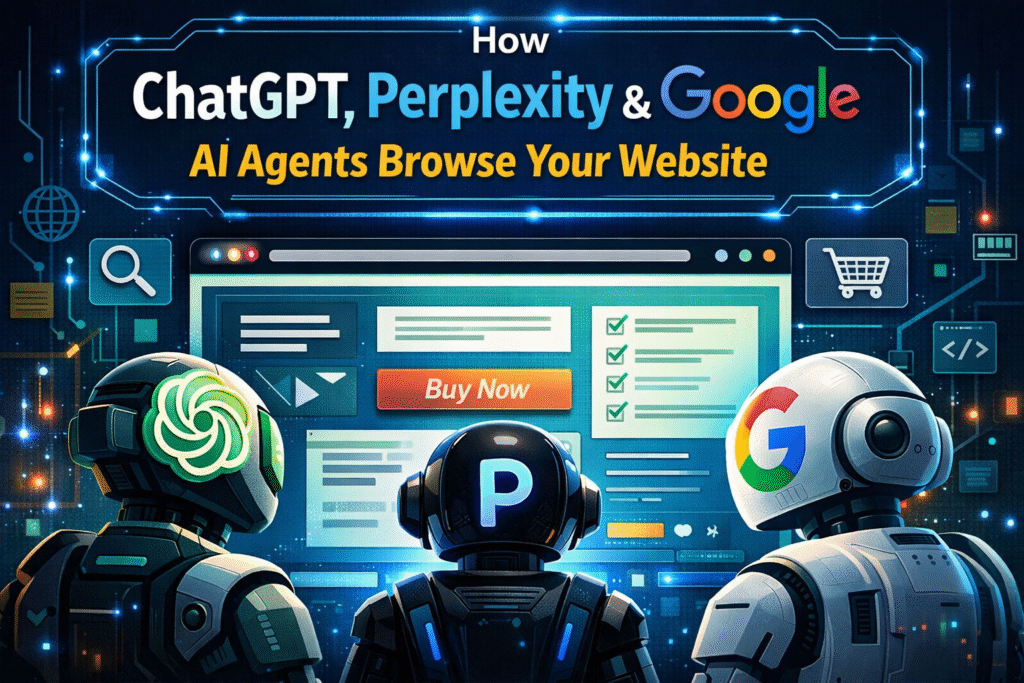
Every time someone asks ChatGPT, Perplexity, or Google a question, there is a chance the answer is pulled directly from your website. These platforms do not rely solely on stored knowledge — they send out automated agents to browse, read, and extract content from websites across the internet.
If you run a business website, a blog, or an online store, understanding how these AI agents work is no longer optional. It affects your traffic, your content strategy, and how your brand appears in AI-generated answers.
This guide breaks it down in plain language.
What Are AI Web Crawlers and Agents?
An AI web crawler is a software program that automatically visits websites, reads the content, and stores or processes it for use in AI systems. These crawlers have been around for decades — Google’s search bot is one of the most well-known — but the new generation of AI-powered agents goes further.
They do not just index pages for search results. They read, summarize, and directly answer user queries using your content, sometimes without sending a single visitor back to your site.
The three platforms doing this at scale right now are OpenAI (ChatGPT), Perplexity AI, and Google (via AI Overviews and Gemini).
The Three Main AI Agents and How They Work
ChatGPT — OpenAI
OpenAI operates two distinct crawlers. GPTBot is used to collect large amounts of web content for training future AI models. ChatGPT-User is deployed in real time when a user activates the browsing feature inside ChatGPT and it visits specific URLs on demand.
GPTBot crawls periodically and in bulk. ChatGPT-User acts more like a human researcher — it fetches a page, reads it, and uses that content to answer a specific question. OpenAI officially respects the robots.txt standard, meaning you can instruct it to stay away from your site or specific pages.
Perplexity AI
Perplexity works differently from the others. It functions as a live search engine, meaning every user query triggers a real-time web crawl. When someone asks Perplexity a question, its bot goes out, visits relevant pages, pulls information, and assembles an answer — all within seconds.
The notable upside is that Perplexity typically cites its sources with clickable links, giving some referral traffic to the original website. The controversy is that Perplexity has been accused on multiple occasions of ignoring robots.txt restrictions, which has frustrated many publishers.
Google — AI Overviews and Gemini
Google uses its long-standing Googlebot for standard search indexing. In addition, it introduced Google-Extended, a separate crawler token specifically for powering Gemini and AI Overview features. This distinction is important because website owners can block Google-Extended without affecting their normal search ranking — the two crawlers operate independently.
AI Overviews appear at the top of Google search results, summarizing content from multiple websites. While they increase visibility for some brands, they also reduce the need for users to click through to the actual source.
Side-by-Side Comparison
| Feature | ChatGPT | Perplexity | Google AI |
|---|---|---|---|
| Bot Name | GPTBot / ChatGPT-User | PerplexityBot | Googlebot / Google-Extended |
| Crawling Type | Training + Live Browsing | Always Real-Time | Indexing + AI Features |
| Cites Your Site | Sometimes | Yes, with links | Sometimes |
| Drives Traffic Back | Rarely | Yes | Less than before |
| Respects robots.txt | Yes | Inconsistent | Yes |
| Can You Block It | Yes | Partially | Yes |
| Uses Data for Training | Yes (GPTBot) | No | Yes (Google-Extended) |
| Speed of Crawl | Periodic | Real-time per query | Scheduled |
How to Control AI Bot Access to Your Website?
You can manage which AI agents are allowed to crawl your site using the robots.txt file located at the root of your domain. Here is a practical example:
# Block OpenAI training bot
User-agent: GPTBot
Disallow: /

# Block Google AI training crawler
User-agent: Google-Extended
Disallow: /

# Block Perplexity bot
User-agent: PerplexityBot
Disallow: /

# Allow regular Google search (keep this active)
User-agent: Googlebot
Allow: /
One important note: never block Googlebot if you care about your standard search visibility. Blocking Google-Extended only removes your site from AI training pipelines — your organic search rankings remain unaffected.
Also keep in mind that robots.txt is a request, not a technical barrier. Well-behaved bots follow it. Poorly-behaved ones may not.
Does AI Crawling Help or Hurt Your Business?
Where it can help:
- Perplexity citations bring referral traffic from users who would not have found you through regular search
- Being referenced in AI answers positions your brand as a credible and authoritative source
- High-quality, well-structured content is more likely to be pulled and cited accurately
- AI visibility is a growing channel that operates independently of traditional SEO rankings
Where it can hurt:
- AI-generated answers reduce click-throughs, meaning your traffic can fall even when your content ranks well
- Your content may be used to train competing AI products without compensation
- There is no guarantee that AI summaries will represent your content accurately
- Attribution is inconsistent across platforms
What Business Owners Should Do Now?
- Review your robots.txt file and confirm which bots currently have access to your site
- Decide whether you want to allow AI training access or restrict it — this is a business decision, not just a technical one
- Structure your content to answer specific questions clearly, as AI tools prefer direct, well-organized information
- Add schema markup to help AI agents better understand your content and context
- Monitor your analytics for changes in referral traffic, especially from AI-related sources
- Continue publishing fresh, expert-level content — recency and credibility are factors in what AI tools choose to cite
Frequently Asked Questions
Q1. Can I completely stop AI bots from visiting my website?
You can block most of them using robots.txt directives, and this works reliably for well-behaved crawlers like GPTBot and Google-Extended. However, compliance is not guaranteed for all bots. For stronger protection, some website owners add IP-based blocking or rate limiting at the server level.
Q2.Will blocking AI bots affect my Google search rankings?
Only if you block Googlebot, which handles standard search indexing. Blocking Google-Extended — the crawler used for Gemini and AI Overviews — has no impact on your organic search rankings. These are separate systems and blocking one does not affect the other.
Q3.Does Perplexity pay websites for using their content?
Not in a standard way. Perplexity provides citation links which can generate referral traffic. In 2024, the company announced a revenue-sharing pilot for publishers, but it covers a very small portion of the web and most websites see traffic benefits at best, not direct payment.
Q4.How do I find out if AI bots are already crawling my site?
Check your server access logs and look for user-agent strings such as GPTBot, PerplexityBot, or Google-Extended. Analytics platforms and tools like Cloudflare also provide bot traffic breakdowns that make it easy to identify and track these visits over time.
Q5.Should small business owners care about this?
Yes. Being cited in an AI-generated answer is a form of free exposure to a growing audience. At the same time, if your written content is the core product of your business — a knowledge base, a course, original research — you may want to control who can use it for training purposes.
Q6.What is the difference between regular SEO and AI SEO?
Traditional SEO focuses on ranking in search results through keywords, backlinks, and technical optimization. AI SEO — sometimes called Generative Engine Optimization — focuses on making your content easy for AI systems to understand, trust, and cite. It prioritizes clear structure, direct answers, factual accuracy, and authoritative tone over keyword density.
Final Thought
AI agents are already visiting your website. The only question is whether you are aware of it and whether your content is set up to benefit from it. Understanding how ChatGPT, Perplexity, and Google browse the web is the first step toward making informed decisions about your digital presence in an AI-driven world.
Watch It on YouTube
Prefer watching over reading? We have covered this topic in a simple, easy-to-follow video on the BizWithTech YouTube channel. It walks you through how AI agents browse your site and what you can do about it.
Watch here:
Discover more from
Subscribe to get the latest posts sent to your email.