
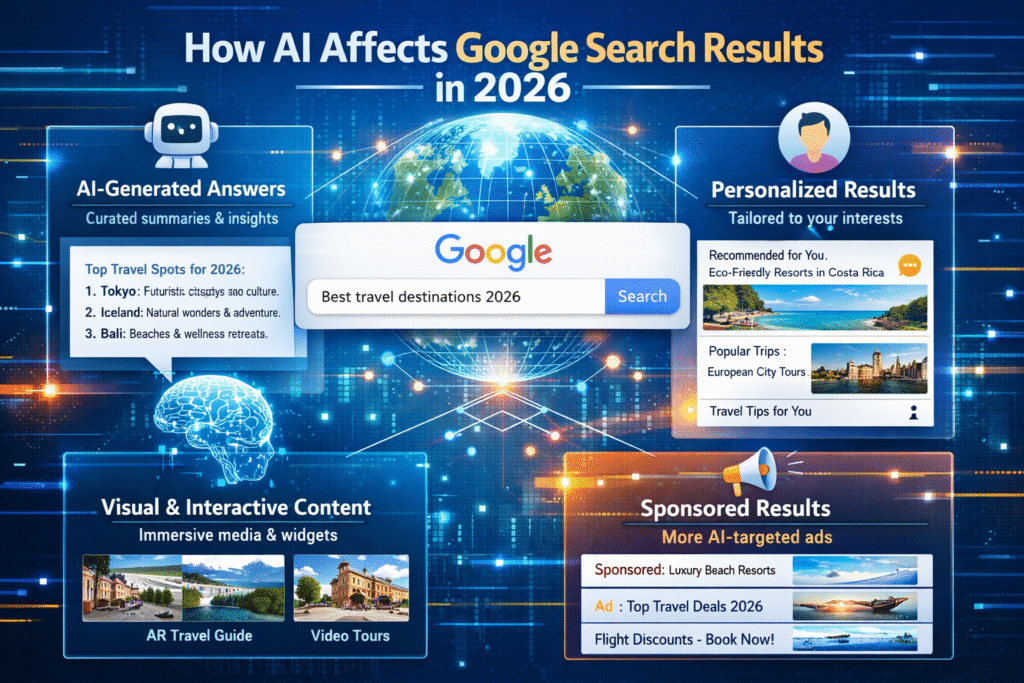
The landscape of Google Search has undergone its most dramatic transformation since the search engine’s inception. In 2026, artificial intelligence isn’t just powering Google’s algorithms behind the scenes—it’s fundamentally reshaping how search results appear, how users interact with information, and what it means to be “found” online. If you’re a content creator, marketer, or business owner, understanding these changes isn’t optional anymore—it’s essential for survival.
The Rise of AI-Powered Search Features
AI Overviews: The New Face of Search
AI Overviews are now one of Google’s most popular search features, used by more than a billion people. These AI-generated snapshots appear at the top of search results, providing quick summaries with key information and links to explore further.
The rollout hasn’t been linear. Google rapidly expanded AI Overviews during 2025, with visibility peaking in July at nearly 25% of queries, before pulling back to less than 16% by November. This retreat suggests Google is fine-tuning the feature based on user feedback and performance data.
What makes AI Overviews particularly significant is their evolution beyond informational queries. AI Overviews increasingly appear on navigational queries, growing from under 1% in January to more than 10% by November, signaling Google’s confidence in expanding this feature to more query types.
AI Mode: Deep Exploration for Complex Questions
For users who want more comprehensive answers, Google introduced AI Mode—a conversational search experience that goes far beyond traditional search. AI Mode uses query fan-out technique, breaking down questions into subtopics and issuing multiple queries simultaneously.
This is search reimagined for the AI era. Users can ask nuanced, multi-part questions like “what’s the difference in sleep tracking features between a smart ring, smartwatch and tracking mat,” and receive detailed, synthesized responses with supporting links. AI Mode drives over 10% increase in usage of Google for the types of queries that show AI Overviews in the U.S. and India.
The technical foundation is impressive. AI Mode uses Gemini to break down queries into logical sub-questions, performs search operations for each sub-query across multiple sources, and synthesizes a single, comprehensive answer.
The Impact on Click-Through Rates and Website Traffic
The statistics paint a stark picture of how AI is changing user behavior. Organic click-through rates for queries featuring AI Overviews have plummeted by 61% since mid-2024, dropping from 1.76% to just 0.61%. For paid search, the impact is even more severe, with a 68% decline in CTR.
However, there’s a surprising countertrend. Click-through rates for keywords with AI Overviews have steadily risen since January, and AI Overviews don’t automatically reduce clicks and may even encourage them. Google has reported that when people do click from search results pages with AI Overviews, these clicks are higher quality, with users spending more time on sites.
The reality is more nuanced than “AI kills website traffic.” By March 2025, only 40.3% of U.S. Google searchers clicked on an organic result, meaning nearly 60% of searches now end without a single click to a traditional website. But this doesn’t mean all traffic has evaporated—it means traffic patterns are fundamentally changing.
What This Means for SEO in 2026
The Fundamentals Still Matter (But They’re Not Enough)
The best practices for SEO remain relevant for AI features in Google Search. There are no additional requirements to appear in AI Overviews or AI Mode, nor other special optimizations necessary. Traditional SEO foundations—crawlability, site structure, quality content, and authoritative backlinks—remain essential.
However, AI Mode shifts the focus from exact-match keywords to semantic depth, because the system analyzes not just phrases but the full context of a query and its subtopics. The game has evolved from optimization for ranking to optimization for understanding.
The Rise of “Search Everywhere Optimization”
A new paradigm is emerging. Search behavior is no longer linear or universal as user behavior shifts from single-destination search to exploration across multiple platforms. Content must now perform well not just in Google’s traditional search results, but also in AI Overviews, AI Mode, ChatGPT, Perplexity, Claude, and other AI-powered discovery platforms.
This has given rise to new terminology:
- GEO (Generative Engine Optimization): Optimizing for AI-generated answers
- AEO (Answer Engine Optimization): Structuring content to be cited in AI responses
- AIO (AI Optimization): The broadest term encompassing all AI-driven discovery optimization
E-E-A-T Is Now Mission-Critical
Google’s emphasis on Experience, Expertise, Authoritativeness, and Trustworthiness (E-E-A-T) has never been more important. In 2026, brand visibility in AI search will hinge on trust. Earned media—social mentions, reviews, quality backlinks—shapes how AI models and users perceive your brand.
LLMs prioritize content from trusted, credible sources. If your brand lacks authority signals across the web—mentions on third-party sites, citations in industry publications, positive reviews—AI systems are less likely to surface your content, regardless of how well-optimized it is.
The New Metrics That Matter
Traditional SEO metrics like rankings and click-through rates tell only part of the story in 2026. SERP fragmentation means brand presence is now distributed across AI Overviews, featured snippets, Knowledge Panels, local packs, product listings, media carousels, and traditional listings.
New metrics are emerging to measure AI search visibility:
- AI Presence Rate: Percentage of target queries where your brand appears in AI responses
- Citation Authority: How consistently you’re cited as the primary source
- Share of AI Conversation: Your semantic presence in AI answers versus competitors
- AI Visibility Index: A combined metric tracking presence, accuracy, and positioning
Practical Strategies for 2026
1. Create Content That AI Systems Can Understand and Cite
AI systems tend to favor content that provides definitive answers to questions. Focus on creating:
- Comprehensive guides that consolidate topics into authoritative resources
- Comparison tables that make differences explicit and scannable
- Statistics pages that centralize data points AI can reference
- Clear definitions and explanations of concepts
2. Build Topical Authority, Not Just Page Authority
Both AI Overviews and AI Mode may use a query fan-out technique—issuing multiple related searches across subtopics and data sources—to develop a response. This means you can’t just optimize one page for one keyword. You need comprehensive coverage of a topic across multiple related subtopics.
3. Optimize for Conversational Queries
Search queries have grown from 6 words to 25+ words as users adopt conversational AI tools. Users are now asking complete questions like “What type of TV is best if I watch a lot of sports?” rather than simply searching “best types of TVs.”
Your content needs to address these longer, more specific questions directly. Focus on the why behind queries, not just the keywords.
4. Maintain Human Oversight and Authenticity
AI-generated content alone will not earn citations. While AI tools can accelerate content creation, thin or generic content won’t be favored by AI search systems. The winning approach combines AI efficiency with human expertise, judgment, and authentic storytelling.
5. Track Multiple Platforms
Don’t just monitor Google. Organizations should assess presence across platforms like ChatGPT, Gemini, Perplexity, and Claude. Each engine returns different answers, highlights different competitors and updates at different rates.
The Monetization Challenge
One significant concern for the industry: Ads alongside AI Overviews rose from about 3% in January to roughly 40% by November. As Google integrates ads more aggressively into AI-powered search experiences, the lines between organic and paid visibility continue to blur.
This creates both challenges and opportunities. Businesses that understand how to appear in both organic AI results and paid placements will have a significant advantage.
Looking Ahead: What’s Next for AI and Search
Gemini 2.5 and Beyond
Google is bringing a custom version of Gemini 2.5, their most intelligent model, into Search for both AI Mode and AI Overviews. This means even more sophisticated understanding of context, better multi-step reasoning, and more accurate responses.
Deep Search Capabilities
For questions requiring thorough research, Google is introducing Deep Search capabilities. Deep Search can issue hundreds of searches, reason across disparate pieces of information, and create an expert-level fully-cited report in just minutes.
Multimodal Search Evolution
AI-powered search isn’t limited to text anymore. Visual search with video is becoming more sophisticated, allowing users to search with what they see around them rather than trying to describe it in words.
The Bottom Line: Adapt or Fall Behind
The transformation of Google Search by AI isn’t a future scenario—it’s happening right now. SEO isn’t disappearing. It’s diverging. One world still revolves around traditional rankings. The other is emerging inside AI-driven answers, where visibility depends on whether a system understands your content well enough to cite it.
Success in 2026 requires operating in both worlds simultaneously. The fundamentals of SEO remain important, but they must be complemented with strategies designed specifically for AI discovery. This means:
- Creating deeper, more authoritative content that demonstrates genuine expertise
- Building brand authority through third-party mentions and citations
- Structuring content so AI systems can easily understand and extract information
- Measuring success across multiple platforms and using new metrics
- Balancing AI tools with human judgment to create authentic, valuable content
The organizations that recognize this shift and adapt their strategies accordingly won’t just survive—they’ll define how discoverability works in the AI era. Those that cling to outdated approaches will find themselves increasingly invisible, not just in traditional search results, but in the AI-powered answers that are becoming the primary way users discover information.
The future of search is here. The question is: are you ready for it?



A really good blog and me back again.