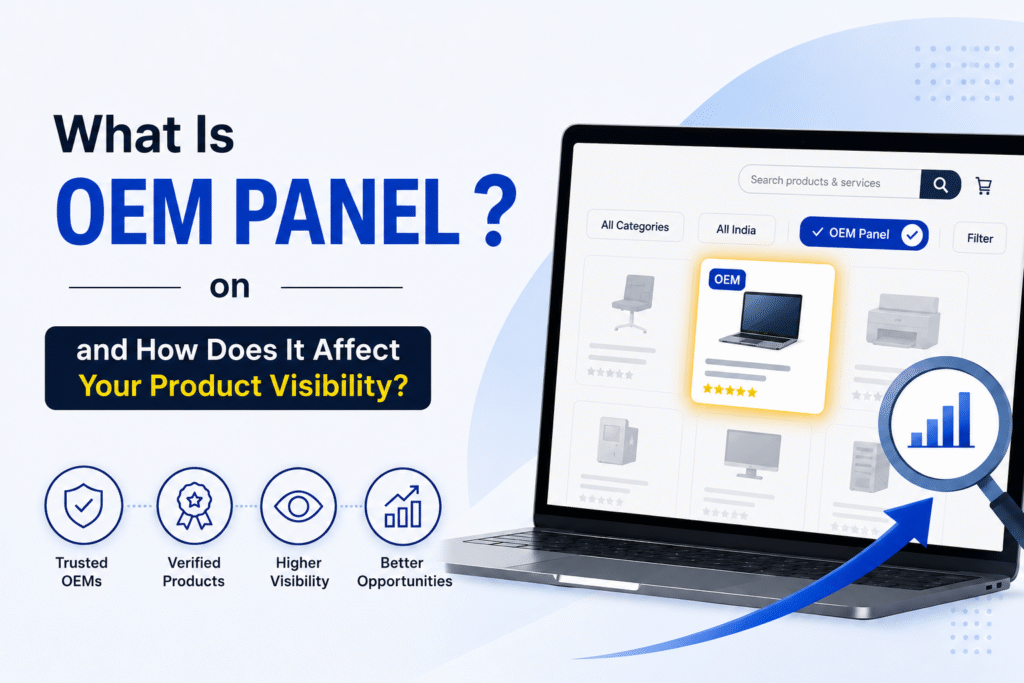
If you sell products on the Government e-Marketplace, you have likely come across the term OEM Panel. Many sellers treat it as a formality, but in reality, it has a direct bearing on how your products rank and get discovered by government buyers. Understanding it is no longer optional — it is essential.
What is GeM?
GeM — Government e-Marketplace — is India’s dedicated online procurement platform for central and state government ministries, departments, public sector undertakings, and autonomous bodies. It was launched by the Ministry of Commerce and Industry to make procurement transparent, efficient, and inclusive. For sellers, it is a direct route to a massive, stable customer base that processes billions of rupees in transactions every year.
What Does OEM Mean on GeM?
OEM stands for Original Equipment Manufacturer. On GeM, the OEM Panel refers to the list of verified manufacturers who are recognised as the original producers of a specific product category. When you register on GeM and map your products, the platform evaluates whether your brand qualifies as an OEM for that category.
On GeM, being classified as an OEM means your product listing carries an authentic manufacturer tag. This directly affects how buyers filter, trust, and purchase your product.
Sellers who are not manufacturers — such as resellers, dealers, or channel partners — can still list products, but their listings are tied to an OEM-approved brand. The distinction matters enormously when buyers apply filters during procurement.
How the OEM Panel Works on GeM?
When a manufacturer registers on GeM and their brand is verified, they are added to the OEM Panel for relevant product categories. This verification process involves submitting documentation such as trademark certificates, GST registration, manufacturing licences, MSME certificates where applicable, and product-specific certifications like BIS or ISO.
Once on the OEM Panel, the manufacturer’s brand appears as a selectable option in that product category. Resellers and authorised sellers must then link their listings to an OEM brand. If no OEM brand exists for a product, new listings may face delays in approval or reduced discoverability.
OEM vs Reseller: Key Differences on GeM
| Parameter | OEM Seller | Reseller / Authorised Dealer |
|---|---|---|
| Brand ownership | Own brand, verified by GeM | Sells under OEM’s brand name |
| Product listing control | Full control — defines specs, images, pricing | Limited — follows OEM-defined specs |
| Buyer trust signal | High — manufacturer badge visible | Moderate — depends on OEM brand reputation |
| GeM filter visibility | Appears in OEM brand filter | Appears under OEM brand, not separately |
| Price competitiveness | Sets benchmark price for the category | Must price competitively around OEM price |
| Documentation required | Extensive — manufacturing proof, certifications | Authorisation letter from OEM plus standard docs |
How OEM Panel Status Affects Your Product Visibility?
1. Search and filter placement
Government buyers on GeM frequently use the brand filter when searching for products. If your brand is not on the OEM Panel, it simply does not appear as a filter option. Buyers looking for a specific manufacturer category will never see your listing in those filtered results. OEM-registered brands get an automatic placement advantage purely from being searchable in that filter dimension.
2. Bid and tender eligibility
Many GeM bids and custom tenders specify OEM brands by name. If your brand is not an approved OEM, you cannot bid for those tenders. Even when tenders appear open, buyers often shortlist vendors based on OEM status. This means a significant share of high-value procurement opportunities are effectively closed to non-OEM sellers.
3. Product approval speed
OEM-registered sellers experience faster product listing approvals. GeM’s internal review process gives precedence to verified manufacturers because their documentation is already validated at the brand level. Resellers linking to an established OEM brand also benefit indirectly, as the product category is already recognised on the platform.
4. Buyer confidence and conversion
When a product listing displays an OEM-verified brand, it signals to the government buyer that they are purchasing directly from or with the authorisation of the original manufacturer. This reduces procurement risk from the buyer’s perspective and translates into higher conversion rates for OEM-listed products compared to unverified brand listings.
5. Pricing power
OEM sellers effectively set the price benchmark for their category on GeM. Since GeM has price comparison mechanisms, an OEM’s listed price becomes the reference point that other sellers — including their own authorised dealers — must align with. This gives manufacturers considerably more control over margin management across their entire distribution chain on the platform.
Common Reasons Sellers Lose OEM Panel Status
GeM periodically reviews OEM registrations. Sellers lose their OEM Panel status or face listing suspension when they do not renew certificates on time, when product specifications listed do not match physical products supplied, when there are grievances filed by buyers about product quality, or when mandatory compliance documents such as BIS certification lapse without renewal. Staying on the OEM Panel is an active process, not a one-time registration.
Steps to Get on the OEM Panel
The process begins with registering as a seller on GeM with your GSTIN and Udyam or MSME registration. After this, you apply for brand approval by uploading your trademark certificate or brand ownership proof. Once the brand is approved, you map products to the appropriate category and submit category-specific certifications. GeM’s backend team validates the documents and, upon successful review, adds your brand to the OEM Panel for the relevant categories.
A complete and accurate documentation submission at the brand approval stage is the single most important factor in reducing OEM Panel approval time. Incomplete submissions are the leading cause of delays.
Frequently Asked Questions
Q1. Can a reseller sell on GeM without linking to an OEM brand?
In most product categories, a reseller must link their listing to a GeM-approved OEM brand. Selling under an unverified or unapproved brand name is not permitted. If the OEM brand does not exist on GeM, the reseller may need to wait until the manufacturer completes OEM registration or can request the manufacturer to do so.
Q2.Does OEM Panel status guarantee product sales on GeM?
OEM status improves visibility and eligibility but does not guarantee sales. Pricing, product quality, fulfilment track record, buyer ratings, and competitive positioning all play a role in actual order conversion. OEM status is best understood as removing barriers to visibility rather than creating automatic demand.
Q3.What happens if my brand trademark is pending but not yet registered?
GeM typically requires a registered trademark certificate for OEM Panel approval. A pending trademark application may not be sufficient for full OEM brand verification. Some sellers proceed with an acknowledged application document, but approval in this scenario depends on the product category and GeM’s current policy, which is updated periodically.
Q4.How long does GeM OEM Panel verification take?
The timeline varies between two weeks and two months depending on the product category, the volume of pending applications, and the completeness of documentation submitted. Categories with mandatory technical certifications such as electronics or medical equipment typically take longer due to the complexity of compliance checks.
Q5.Can a foreign manufacturer get on the GeM OEM Panel?
Foreign manufacturers must have a registered Indian entity — such as a subsidiary, liaison office, or authorised Indian representative — to register on GeM. Direct registration by a foreign company without Indian business registration is not currently supported. The Make in India policy also gives preferential treatment to domestically manufactured goods in certain categories.
Q6.Is OEM Panel status relevant for service providers on GeM?
The OEM Panel concept primarily applies to product categories. Service providers on GeM operate under a different registration and empanelment framework. However, service sellers offering software products or bundled hardware-software solutions may encounter OEM-related requirements when the offering includes physical products.
The Bottom Line
For any manufacturer selling physical products on GeM, getting on the OEM Panel is not a competitive edge — it is the baseline for serious participation. It determines whether buyers can find you, whether tenders are accessible to you, and whether your pricing holds weight in the category. If you are currently selling on GeM without OEM status or are planning to enter the platform, prioritise brand verification as your first milestone. Everything else — listings, bids, orders — follows from that foundation.
Discover more from
Subscribe to get the latest posts sent to your email.