
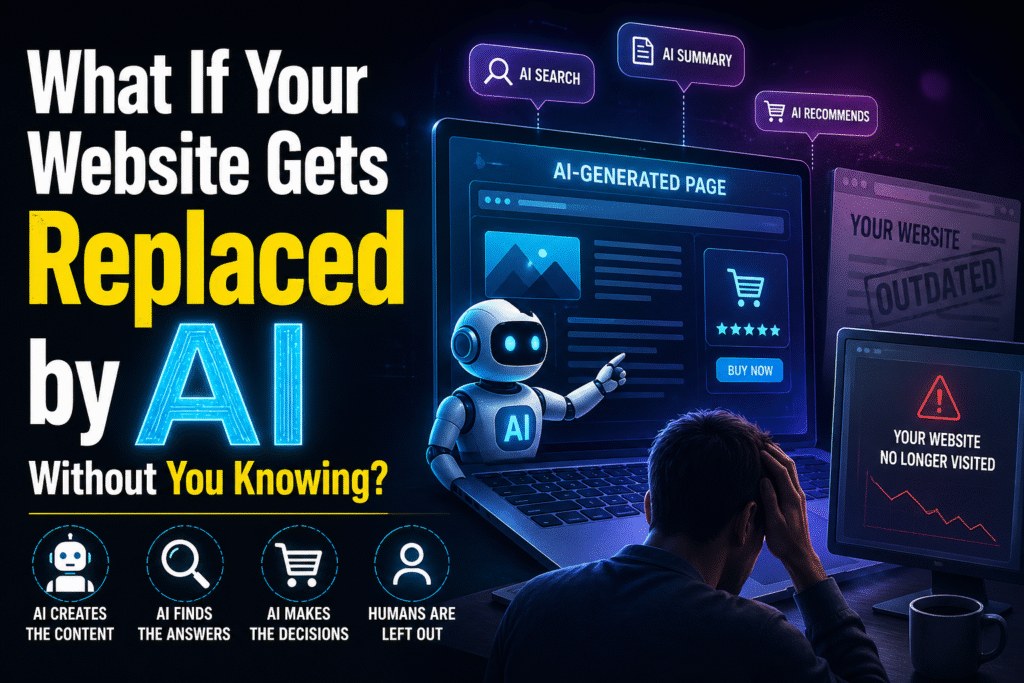
Imagine you own a bakery in Delhi. You have a website, a Google listing, and decent reviews. A potential customer picks up their phone and types into ChatGPT: “best custom cake shop near me.” The AI responds with three names. Yours is not one of them — even though your website exists, your cakes are excellent, and you have been in business for six years.
You lost that customer without ever knowing they existed. No missed call. No abandoned cart. Nothing. This is the quiet replacement problem, and it is happening to thousands of businesses right now.
What Is Actually Going On?
AI assistants like ChatGPT, Google Gemini, and Claude are trained on enormous amounts of text pulled from the internet. Think of it like a student who read millions of websites, articles, and reviews before an exam — and now answers questions from memory. Your website was part of what that student read, but here is the catch: the reading stopped at a fixed point in time called the training cutoff.
If you redesigned your website six months ago, added new services, or changed your pricing — the AI does not know. It still describes your business the way it remembered it from older data. And if your website was thin on content to begin with, the AI may skip you entirely and mention a competitor whose website gave it more to work with.
“AI does not see your logo, your fonts, or your hero image. It reads your words. If your words are weak, your business is invisible.”
A Simple Example to Make This Clear
Suppose you run a digital marketing agency called BrightReach in Faridabad. A startup founder asks Perplexity AI: “Which digital marketing agencies in Faridabad are good for startups?”
The AI scans its training data and real-time indexed pages. It finds that your competitor, PixelGrow, has a detailed blog post titled “How We Help Startups Scale in 90 Days,” a Clutch.co profile with 40 reviews, and three mentions in a local business publication. Your agency, BrightReach, has a homepage with five lines of text and a contact form.
The AI recommends PixelGrow. Not because they are better — but because they gave the AI more to work with. You were replaced not by a better product but by better-documented content.
Signs Your Website Is Being Bypassed
Your traffic from Google may stay the same or even grow, while actual inquiries and leads quietly fall. Customers who do reach you mention information that is months out of date — because an AI pulled it from an old cached version of your site. When you test it yourself and ask an AI about your own business, the description is vague, incomplete, or simply wrong. These are not random problems. They are symptoms of low AI visibility.
Traditional Website vs. AI-Visible Website
| Factor | Traditional Website | AI-Visible Website |
|---|---|---|
| Content format | Designed for human readers | Structured for machine extraction — schema, clear headings |
| Update frequency | Updated occasionally | Published regularly so AI tools always have fresh data |
| Authority signals | Backlinks and domain age | Mentions in sources that LLMs treat as credible |
| Answer coverage | Product pages and service lists | Explicit Q&A, FAQs, definitions, real-world examples |
| Discoverability | Search engine ranking | Being cited or referenced inside AI responses |
Why Small Businesses Are More at Risk?
Think of it this way. When someone asks an AI about a well-known brand like Zomato or Nykaa, the AI has thousands of references to draw from — news articles, Wikipedia entries, reviews, press releases, interviews, and more. The picture is rich and accurate.
When someone asks about your small business, the AI may have only your website and one or two directory listings to work from. If those sources are sparse or outdated, the AI either skips you, gets your details wrong, or fills the gap with a competitor who documented themselves better.
A salon in Pune that publishes a monthly blog answering questions like “how long does keratin treatment last” or “is balayage suitable for Indian hair” is far more likely to appear in AI responses than a salon with an identical homepage that says “we offer all hair services, call us today.”
What You Can Do About It Right Now?
The first thing to do is test what AI actually says about your business. Open ChatGPT, Gemini, Claude, and Perplexity. Search your business name. Search the type of service you offer in your city. Read every response carefully. Note what is wrong, what is missing, and who appears instead of you. That gap is your content problem, and it has a solution.
Start writing content that directly answers the questions your customers actually ask. Not vague brand content — specific, factual answers. If you run a CA firm, write a plain-language post explaining what documents a first-time taxpayer needs. If you sell fitness equipment, explain the difference between a home gym setup under 20,000 rupees versus 50,000 rupees. These are the exact queries people are feeding into AI assistants, and structured answers to them are what AI extracts and cites.
Use proper headings that describe your content clearly. Add an FAQ section to your key pages — not for show, but because AI systems love pulling clean question-and-answer pairs directly into their responses. Add schema markup to your site so that crawlers and AI indexers can understand your business type, your location, your services, and when the page was last updated.
Get mentioned in places the AI trusts. A feature in an industry newsletter, a listing on a credible review platform, a quote in a local news article — these external references signal to AI models that your business is real, active, and worth including in answers.
“Being optimized for search engines and being optimized for AI are no longer the same task. They overlap — but the gaps between them are growing fast.”
Frequently Asked Questions
Q1. Can AI really replace my website as a customer touchpoint?
For informational queries, yes — increasingly so. When someone asks an AI which accounting software to use, what a particular service costs, or which vendor to trust in a given city, they may get a complete answer without visiting a single website. For transactional steps like booking or purchasing, users still land on websites — but AI now controls the top of that funnel. If you are not present in the AI answer, you never get a chance at the transaction.
Q2.How do I find out if an AI is describing my business incorrectly?
Test it directly and test it often. Ask ChatGPT, Claude, Gemini, and Perplexity about your business name, your services, your location, and the problems you solve. Compare what they say against your actual current offerings. If a competitor appears in your place, look at their content strategy — it will usually tell you exactly what you are missing.
Q3.Does SEO still matter if AI is taking over search?
SEO still matters because most AI search products use the same indexed web data as Google. However, the emphasis shifts away from keyword stuffing and backlink quantity toward content clarity, factual depth, structured formatting, and citation by trusted sources. Think of it as SEO evolving rather than disappearing. The fundamentals of being useful and clear have always mattered — they just matter even more now.
Q4.What kind of content helps AI represent my business accurately?
Content that answers specific questions in plain, direct language. FAQ pages, comparison articles, how-to guides, and original data or case studies from your own work. Avoid vague marketing language like “we deliver excellence” or “your trusted partner.” AI models extract factual statements — they cannot do anything with brand sentiment.
Q5.Is there a way to get my website cited inside AI answers?
There is no guaranteed mechanism, but certain practices raise your probability significantly. Being cited by reputable external sources, maintaining well-structured and regularly updated content, and using proper schema markup all help. AI products that use real-time retrieval like Perplexity or Bing Copilot are more likely to surface your pages if they are technically sound, factually clear, and recently updated.
Q6.Should I rebuild my entire website to fix this?
Not necessarily. A full rebuild is rarely the answer. In most cases, what is needed is a content strategy update — adding FAQ sections to existing pages, rewriting thin service pages with specific factual detail, getting listed on credible third-party platforms, and publishing regularly on topics your customers actually search. The structure of your website matters, but the words on it matter more.
The Bottom Line
Your website being live does not mean it is working. A customer who never visits your site because an AI already answered their question is a customer you lost without knowing. The businesses that treat AI visibility as seriously as they once treated Google rankings will hold their ground. Those that wait for a dramatic signal — a sudden traffic crash, a sharp drop in leads — may find that the replacement already happened, one AI answer at a time, while everything on the surface looked perfectly fine.
Discover more from
Subscribe to get the latest posts sent to your email.