
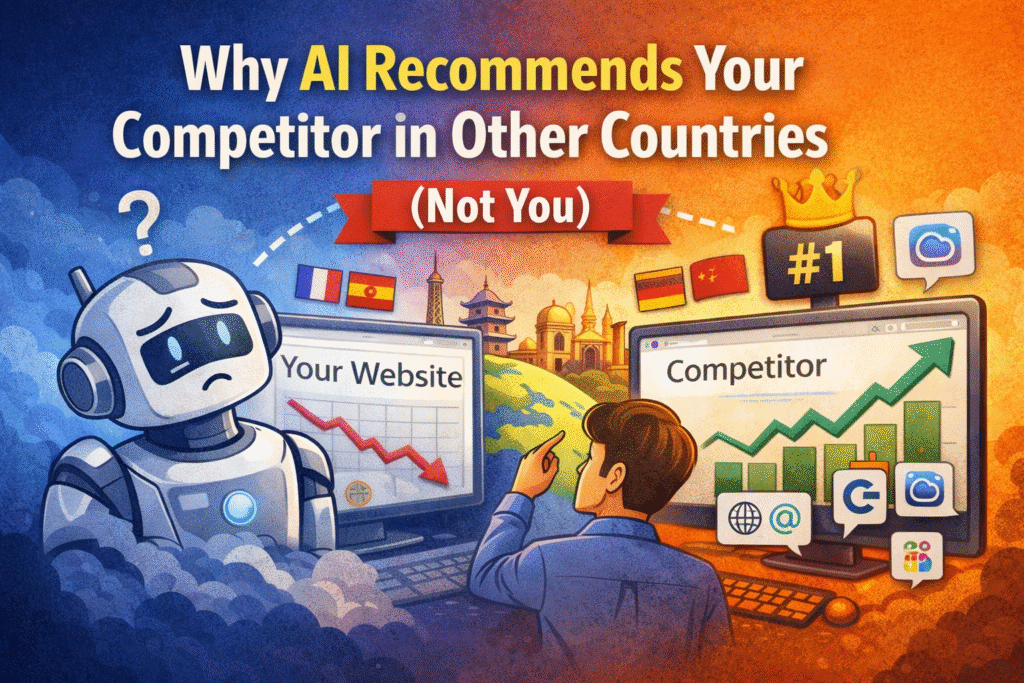
You searched your brand name in an AI tool and found your competitor showing up instead — in Germany, in Brazil, in the UAE. That’s not a glitch. That’s a gap in your digital strategy, and it’s costing you customers you never even knew you were losing.
The Invisible Border Problem
AI tools like ChatGPT, Gemini, and Perplexity don’t think in continents. They think in data. When someone in Tokyo or Toronto asks “best CRM software for small businesses,” the AI pulls from what it has learned — reviews, directories, articles, backlinks, and brand mentions indexed across the open web. If your competitor has built that presence in those markets and you haven’t, the AI simply doesn’t know you exist there.
This is the new SEO war, and most brands don’t even know they’re losing it.
Why AI Picks What It Picks
AI recommendations are not random. They are built on a structured logic of trust signals. Understanding this logic is the first step to fixing your visibility.
| Signal | What It Means for AI | Your Action |
|---|---|---|
| Local language content | AI associates your brand with regional searches | Publish content in native languages |
| Country-specific backlinks | Indicates authority in that geography | Get listed in local directories and press |
| Review platform presence | G2, Trustpilot, Capterra mentions by region | Collect reviews from international users |
| Local case studies | Proves relevance to regional audiences | Feature global client stories |
| Structured data / schema | Helps AI parse your brand correctly | Add geo-targeted schema markup |
| Social mentions by region | Signals cultural relevance | Build country-specific social presence |
What Your Competitor Is Doing That You’re Not?
Your competitor is not smarter. They are more present. Here is exactly what that presence looks like in practice.
They are getting covered in regional tech blogs and news outlets in those markets. They have localized landing pages that speak the language — not just translated, but culturally adapted. They are earning reviews on platforms that dominate in specific countries, like Trustpilot in Europe or Clutch in North America. They are being mentioned in forums, Reddit threads, and LinkedIn posts where people in those regions are actively asking for recommendations. AI learns from all of this.
Your brand, meanwhile, may have excellent content — but only in English, only from US-based sources, only relevant to one geography.
The GEO Gap Nobody Talks About
Traditional SEO optimizes for search engines. GEO — Generative Engine Optimization — optimizes for AI. The rules are different.
Search engines rank pages. AI tools recommend brands. To show up in AI recommendations, you need to be the answer to a question, not just the top result for a keyword. That means your brand needs to be cited in contexts where people are asking “which brand should I use” type questions — in forums, in comparison articles, in industry reports, and in expert roundups.
If those citations don’t exist in German, Portuguese, or Arabic — the AI simply has no data to recommend you in those markets.
How to Fix Your International AI Visibility?
The solution is not a single campaign. It is a systematic presence-building effort across the markets that matter to your business.
Start with a market audit. Identify which countries drive or could drive meaningful revenue for you. Then test AI tools by asking relevant product or service questions in those local contexts. See who appears. That list of names is your competitive benchmark.
Next, invest in localized content — not just translated pages, but original articles, case studies, and thought leadership pieces written for regional audiences. Partner with local journalists, bloggers, and micro-influencers who create content that AI tools actually scrape and learn from.
Get listed on country-dominant review and directory platforms. Earn press mentions in regional business publications. Build a backlink profile that signals geographic authority to both traditional search engines and AI systems.
Finally, structure your website data correctly. Use hreflang tags, country-specific schema markup, and localized metadata so that when AI parses your brand, it understands where you operate and who you serve.
The Cost of Doing Nothing
Every month you delay is another month of AI tools directing international buyers to your competitors. Unlike paid ads, AI recommendations don’t switch off when budgets run out — they compound over time based on accumulated trust signals. Your competitor is building that compounding advantage right now.
This is not a future problem. People in over 90 countries are actively using AI tools to make purchasing decisions today. B2B buyers, SaaS decision-makers, and e-commerce shoppers are all asking AI “who should I trust?” before they ever visit a website.
Watch: How AI Decides Who to Recommend
For a visual breakdown of exactly how AI recommendation engines work and how brands can influence them, watch our detailed walkthrough on the BizWithTech YouTube channel and the step-by-step tutorial will walk you through a live audit of your own brand.
Frequently Asked Questions
Q1. Why does AI recommend my competitor instead of me, even if my product is better?
AI doesn’t evaluate product quality directly. It recommends brands that have the strongest volume of credible mentions, reviews, and citations across trusted sources — especially in the geography of the person asking. A better product with weaker digital presence will lose to an average product with strong presence.
Q2. Does this only affect large businesses or global brands?
Not at all. In fact, mid-sized and growing businesses are the most vulnerable because they often have strong domestic presence but almost no structured international footprint. AI picks up on that gap immediately.
Q3. How long does it take to improve AI visibility in a new country?
Realistically, a focused GEO strategy takes three to six months to show measurable results. It depends on how competitive the market is, how much content you produce, and how quickly you earn regional citations and reviews.
Q4. Is GEO the same as SEO?
They overlap but are not the same. SEO targets ranking in search results. GEO targets appearing in AI-generated answers and recommendations. GEO relies more heavily on brand authority signals, citation volume, and contextual relevance than on keyword optimization alone.
Q5. Should I translate my existing content or create new content for each market?
Both are needed, but original content performs significantly better. Translated content helps with language accessibility, but AI tools favor content that is natively created for a market — with local examples, local references, and cultural relevance baked in.
Q6. Which AI tools should I be optimizing for?
ChatGPT and Perplexity are the most widely used for recommendation-style queries globally. Gemini has strong integration with Google’s ecosystem. Focus on these three first, then expand to regional tools like Baidu’s AI in China or Yandex’s AI assistant in Russia if those markets are relevant to you.
Discover more from
Subscribe to get the latest posts sent to your email.