Let’s be honest.
You set up your llms.txt file last year. You felt good about it. You told your team “we are AI ready now.”
But the truth is — AI agents have already moved on. And right now, your brand might be completely invisible to them.
Do not worry. By the end of this article, you will understand exactly what is happening and exactly what to do about it. No confusing tech terms. Simple examples. Plain language.
First — What Even Is llms.txt?
Imagine you walk into a library.
The librarian hands you a piece of paper that says:
“We have books on cooking, history, science and business.”
That is it. No author names. No details. No way to know which book is the latest, which one is most trusted, or which one actually answers your question.
That is exactly what llms.txt is for AI agents.
It is a simple list that says “here is what we have.” Nothing more.
For 2024 that was perfectly fine. For 2026 it is simply not enough anymore.
So What Exactly Changed in 2026?
Think of AI agents like a very smart personal assistant that your customer hired to do their research.
When your customer asks:
“Which accounting software is best for my small business under $20 per month?”
The AI assistant does not just Google it. It behaves like a proper researcher.
It checks if your pricing is current or outdated. It compares your features against three other competitors. It checks whether your information looks trustworthy or just random text on a webpage. Then it makes a recommendation in seconds.
If your website is just plain text with no structure, no clear facts, and no trust signals, the AI skips your brand completely.
And you never even know it happened.
The 3 Big Problems With llms.txt Today
Problem 1 — It Is Just a List With No Relationships
Here is a simple example.
Imagine you are buying a phone. You ask the shopkeeper about it. The shopkeeper hands you a paper that just says:
“We sell phones, accessories, and covers.”
You ask “does the phone support 5G?”
The shopkeeper says “I only have this paper. I cannot answer that.”
That is llms.txt. It tells AI you exist. But it cannot tell AI what your product actually does, which plan includes which features, or how everything connects together.
When an AI agent is doing a comparison query for your potential customer, it needs those connections. Without them it guesses. And when it guesses, it often gets it wrong. Your brand pays the price for that wrong guess.
Problem 2 — It Is Like Reading Yesterday’s Newspaper
Imagine you are reading yesterday’s newspaper today.
The news is already old. The prices are already changed. The offers are already expired.
That is what happens when your llms.txt file is not updated regularly. Every time you change your pricing, launch a new feature, or remove an old product, your llms.txt needs a manual update.
Miss one update and the AI is confidently telling your potential customers the wrong price or the wrong features.
The customer leaves. You never find out why.
Problem 3 — There Is No Proof That Your Information Is Trustworthy
Imagine two people telling you two different things about the same restaurant.
Person A says “their food is amazing.”
Person B says “their food is terrible.”
Who do you believe?
You believe the one who says “I went there last Tuesday. Here is my receipt. Here is my photo.”
That is called a trust signal. That is called proof.
llms.txt has no timestamp. No author name. No proof that the information is current.
So when AI has to choose between your brand and a competitor, it picks the one with clear proof. If that is not you, you lose that recommendation every single time.
So What Do AI Agents Actually Want in 2026?
Think of it like building a four floor building. Each floor makes your brand stronger and more trusted by AI agents.
You do not have to build all four floors today. But you need to understand what each floor does and why it matters.
Floor 1 — Your Brand’s Official ID Card (JSON-LD Schema)
JSON-LD is a structured data file that tells AI agents clearly who you are, what you sell, what your pricing is, and what your features are.
Here is a real life example to make it simple.
When you search “best pizza near me” on Google, some results show up with star ratings, price range, and opening hours right there in the search result. That happens because of JSON-LD structured data. The restaurant told Google exactly what it needed to know in a format Google could read instantly.
AI agents work exactly the same way. They read your JSON-LD data and instantly understand your brand without having to guess from random paragraphs of text.
Pages with proper structured data are 2.3 times more likely to appear in AI generated responses compared to pages without it. That number alone should make this a priority.
Floor 2 — A Map That Shows How Everything Connects (Entity Relationship Map)
AI agents do not just want to know what you sell. They want to know how everything fits together.
Here is a simple example.
Your company sells three plans. Basic, Pro, and Enterprise.
Basic allows 5 users. Pro allows 20 users. Enterprise allows unlimited users.
If an AI agent does not have this relationship clearly mapped out, it cannot accurately answer a simple question like “does this tool work for a team of 50 people?”
Without the map it guesses. With the map it answers correctly and confidently recommends your brand to the right customer.
An entity relationship map is exactly this. It defines all the connections between your products, plans, features, and use cases so AI agents can navigate your brand like a well organized catalog.
Floor 3 — A Live Data Feed Instead of a Static File (Content API)
Think of the old llms.txt as a printed pamphlet.
Now think of the new approach as a live digital display board. Like the departure board at an airport. Always updated. Always current. Never wrong.
This is called a Content API. It is a live endpoint that always gives AI agents your current pricing, current features, and current case studies without any manual update needed.
Anthropic introduced a standard in late 2024 called the Model Context Protocol, commonly known as MCP. OpenAI, Google, and Microsoft have all adopted it. This is exactly the direction everything is heading. Real time structured data exchange between brands and AI agents.
What this means practically: when your pricing page updates, the AI knows immediately. No manual work. No outdated information. No lost customers because of wrong pricing.
Floor 4 — A Trust Certificate on Every Fact (Provenance Metadata)
This is the most important layer and the one most brands completely ignore.
Here is a simple example.
You visit a doctor. The doctor recommends a medicine. You would trust it more if:
Option A — The doctor verbally says “just take this.”
Option B — The doctor gives you a written prescription with the date, their name, their registration number, and exact dosage details.
Option B is obviously more trustworthy. Not because the medicine is different. But because the proof is clear.
Provenance metadata does exactly this for your content. Every fact on your website carries a timestamp, an author name, and a version number.
When AI has to choose between two conflicting facts — yours and a competitor’s — it always picks the one with clear proof attached. This single layer can be the difference between being recommended and being skipped.
A Simple Side by Side Comparison
Here is a clear table showing the difference between the old way and the new way:
| What AI Needs | llms.txt Old Way | New Architecture |
|---|---|---|
| Basic content list | Yes | Yes |
| Current pricing | No | Yes |
| Product relationships | No | Yes |
| Trust and verification | No | Yes |
| Automatic updates | No | Yes |
| Works fully with AI agents | Partially | Fully |
| Ranks better than competitor | No | Yes |
The difference is not just technical. It is the difference between being recommended and being ignored entirely.
Where Do You Actually Start?
You do not need to build everything at once. That would be overwhelming and unnecessary. Start with three simple things this quarter and build from there.
Step 1 — Audit Your JSON-LD Schema
Go to your most important pages. Your homepage, pricing page, and top product pages. Check if your JSON-LD schema is accurate, complete, and clearly structured. Make sure your pricing, features, and product information are all correct and up to date.
This single step puts you ahead of the majority of brands who have no structured data at all.
Step 2 — Create One Live Structured Endpoint
Pick your single most important piece of information. For most brands that is pricing and core features. Create a programmatic endpoint that pulls this data directly from your CMS so it is always current.
Stop updating it manually. Let the system keep it accurate automatically.
Step 3 — Add Provenance Metadata to Key Facts
On every important public facing fact, add a simple timestamp, an author name, and a version reference.
This does not require a massive technical overhaul. Start small. Even adding update dates to your key pages gives AI agents a reason to trust your information over an undated competitor page.
The Brands That Start Now Will Define the Next Decade
Here is something worth thinking about.
The brands that implemented structured data back in 2012 when Google first launched Schema.org did not wait for a guarantee. They built toward the principle and let the standard form around their work. Those brands shaped how Google consumed structured data for the next ten years.
The same thing is happening right now with AI agents.
The brands building clean, structured, verified content architecture today are not just optimizing for 2026. They are defining what AI ready brand infrastructure looks like for the next decade.
The window is still open. But it will not stay open forever.
Every month you wait is another month your competitor gets recommended instead of you.
Conclusion
llms.txt was a good first step. Nobody is saying it was a mistake. It was the right idea at the right time.
But in 2026, AI agents are not looking for a table of contents. They are looking for a brand they can trust, verify, and recommend with confidence.
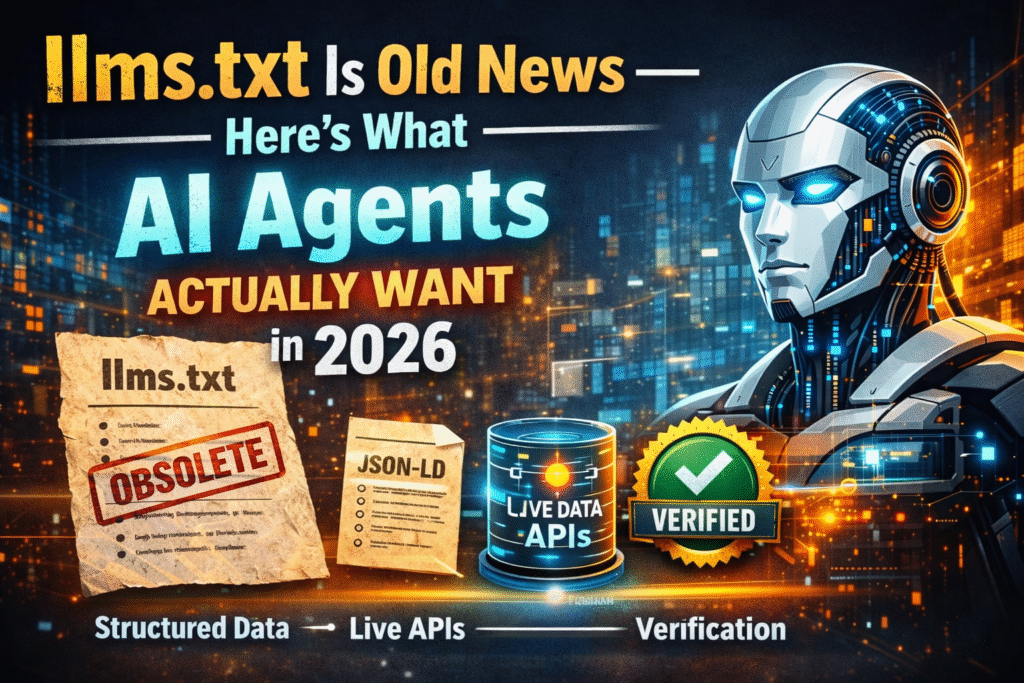
The four layer architecture — structured schema, entity relationships, live content APIs, and provenance metadata — is what gives AI agents exactly that.
You do not need to build it all today. But you need to start somewhere. And the best time to start is right now before your competitors figure this out.
At BizWithTech, we help growing businesses build exactly this kind of AI ready content architecture. From structured schema setup to content API design, we help your brand show up where your customers are already searching.
If you are ready to make your brand truly AI ready, start the conversation with us today.
Found this article helpful? Share it with your team. Because the brand that understands this first will be the one AI recommends most.
Discover more from
Subscribe to get the latest posts sent to your email.