Imagine opening your analytics dashboard and seeing traffic down 25%. Your CEO is nervous. Your team is scrambling. But then you check your sales numbers — and they’re actually up.
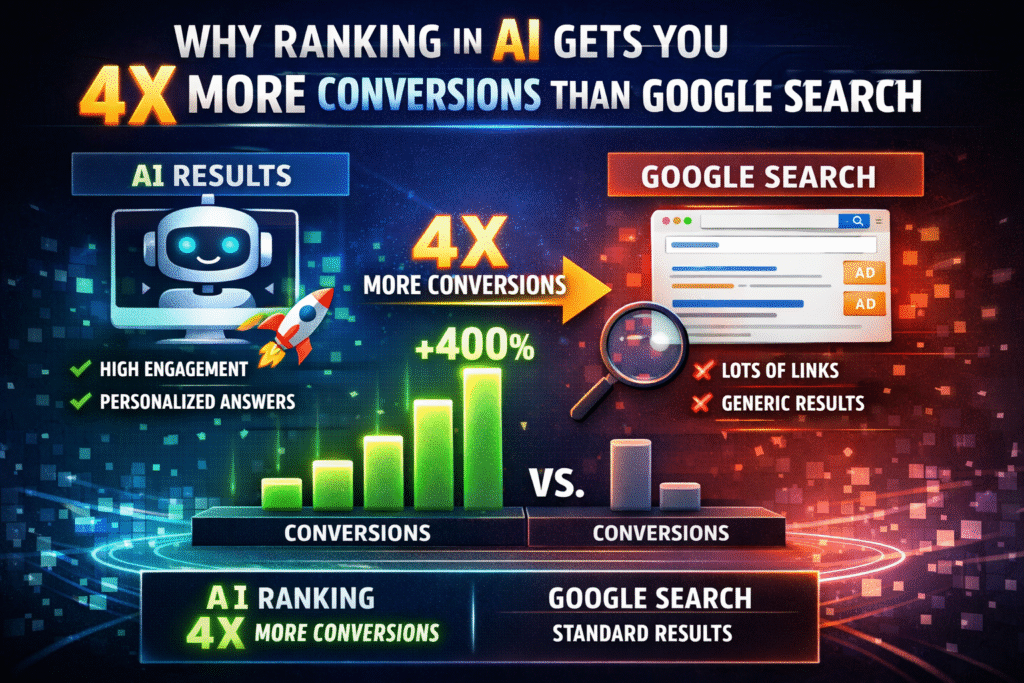
This is not a glitch. This is the new reality of search. And it all comes down to one shift that most marketers are still sleeping on: AI answer engines are replacing traditional search — and the buyers they send convert at 4x the rate of anyone Google ever delivered.
The Old Way vs. The New Way of Search
Think about how people searched five years ago. Someone types “project management software.” They get ten blue links. They click three of them, skim two, bounce off one, and maybe fill out a form. The intent was broad. The journey was messy.
Now think about how that same buyer searches today. They open ChatGPT and type:
“What’s the best project management tool for a 15-person remote SaaS team that already uses Slack and needs client-facing portals under $30 per user?”
That is not a search query. That is a buying brief. By the time they finish that AI conversation — which on average lasts 23 minutes with 5 to 8 follow-up questions — they already have a brand in mind. Possibly yours. Possibly your competitor’s.
The difference between those two outcomes? Whether your brand shows up in the AI’s answer.
The Numbers That Tell the Whole Story
Here is a side-by-side look at what Forrester Research found when comparing traditional Google search visitors vs. visitors arriving from AI answer engines:
| Metric | Google Search Visitor | AI Engine Visitor |
|---|---|---|
| Average query length | 3–4 words | 23 words |
| Research session length | 2–3 minutes | 23 minutes |
| Follow-up questions per session | 1–2 | 5–8 |
| Time spent on your site | Baseline | 3x longer |
| Conversion rate | Baseline | 2–4x higher |
| Average order value | Baseline | Higher |
| Monthly traffic growth (channel) | Declining YoY | +40% month over month |
The pattern is clear. AI visitors arrive warmer, stay longer, and buy more. The click volume is lower, but every click carries far more intent.
Which LLMs Are Sending Traffic — And How They Decide Who to Recommend
Not all AI engines work the same way. Each has a different content diet, a different index, and a different logic for deciding which brands get cited. Here is how the major players break down:
| LLM / AI Engine | Primary Index Source | What It Weights Most | Content Formats It Prefers |
|---|---|---|---|
| ChatGPT (OpenAI) | Bing + its own web crawl | Off-site mentions, brand authority, trusted publications | FAQ content, structured answers, comparison guides |
| Perplexity AI | Bing + Sonar (own index) | Real-time web sources, cited references | Direct answers, data-backed content, original research |
| Google Gemini | Google index | E-E-A-T signals, structured data, site authority | Long-form authority content, schema markup |
| Microsoft Copilot | Bing index | Bing SEO signals, off-site authority | Conversational content, product pages, reviews |
| Claude (Anthropic) | Training data + web (in search mode) | Trustworthy sources, clear reasoning, original insight | Well-structured explanations, unique perspectives |
| Meta AI | Bing + social signals | Social proof, community discussions, user-generated content | Reddit threads, Facebook groups, community content |
The big insight from this table: ChatGPT, Perplexity, Copilot, and Meta AI all pull primarily from Bing’s index. This means Bing is now the single most important distribution network for AI visibility — more important than most marketers currently treat it.
Google Gemini is the exception. It relies on Google’s index, which means your existing Google SEO efforts directly feed Gemini visibility.
Why AI Visitors Convert at 4x — The Real Reason
Most people assume it is because AI attracts smarter buyers. That is not quite it.
The real reason is pre-decision trust.
When someone finds your brand through a Google search, they arrive with zero context. They do not know if you are credible, whether you are the right fit, or how you compare to alternatives. Your website has to do all of that work.
When someone finds your brand through an AI conversation, they arrive having already spent 23 minutes in a session where an AI cross-referenced your brand against competitors, validated your credibility, and answered their objections. They did not just find you — they were recommended you.
That is the difference between a cold introduction and a warm referral. And warm referrals close at a completely different rate.
“Brand familiarity is built in answer engines before purchase intent even crystallises in the buyer’s mind.” — Nikhil Lai, Principal Analyst, Forrester Research
Your Brand Is Being Discussed in AI Right Now — With or Without You
Here is the uncomfortable truth. Every day, potential buyers are having AI conversations about your product category. They are asking ChatGPT which brands to trust. They are asking Perplexity to compare options. They are asking Gemini for recommendations.
Those conversations are happening whether you optimise for them or not. The only question is whether your brand shows up as the answer — or your competitor does.
For B2B companies specifically, the urgency is even higher. Forrester data shows that GenAI has become the number one source of information for business buyers evaluating purchases of $1 million or more — ahead of customer references, vendor websites, and analyst reports. Your largest deals are being influenced by AI before your sales team even enters the picture.
Want to see exactly how ChatGPT, Perplexity, and Gemini decide who to recommend? Watch our full breakdown below.
How to Show Up in AI Answers: 5 Things to Do Now
1. Push your sitemap to Bing via IndexNow Since ChatGPT, Perplexity, and Copilot all pull from Bing, submitting your sitemap directly to Bing via the IndexNow protocol is the fastest way to feed fresh content into every non-Google AI engine. This is a 15-minute technical task with compounding distribution benefits.
2. Build content that answers specific questions, not broad topics AI rewards precise answers to real questions buyers ask during research sessions. Create FAQ pages, comparison guides, and direct-answer content mapped to the exact multi-word queries your buyers use. Think 23-word questions, not 3-word keywords.
3. Build off-site authority aggressively AI engines trust what others say about your brand more than what you say about yourself. Reddit threads, Quora answers, G2 reviews, YouTube videos, and mentions in trusted publications all shape how AI describes your brand. Contribute to these channels with data and perspective they cannot generate themselves.
4. Pre-render pages for AI bots Most AI crawlers cannot render JavaScript-heavy pages. Cloudflare data shows that Claudebot crawls 38,000 pages for every one referral it sends — meaning it needs to be able to read your content easily and at scale. Pre-render a clean HTML version for bots while keeping the full experience for human visitors.
5. Stop measuring clicks. Start measuring citations. Citation share — how often your brand is referenced in AI responses compared to competitors — is the new SEO metric that matters. Track mention share and branded search volume. These are the leading indicators of market share growth in the AI era.
What to Tell Your CEO When Traffic Falls
The hardest internal conversation right now is explaining why less traffic is actually good news.
Here is the framing that works: Total traffic volume is a legacy metric. Revenue per visitor is the metric that matters.
If your traffic drops 20% but your conversion rate doubles and your average order value increases, that is a net business gain. AI is filtering out the browsers and sending you the buyers. The chart that should be on your boardroom slide is not sessions — it is citation share, branded search volume, and revenue per visitor.
The Window Is Still Open — But Not for Long
AI visibility is still in its early-mover phase. The brands building citation authority now are setting a baseline that becomes progressively harder for competitors to close — exactly like domain authority in the early days of SEO.
In 12 months, AI answer engine optimisation will be a standard expectation, not a competitive advantage. The advantage exists right now, today, for brands willing to act before the window closes.
Your traffic chart is not the story. Your conversion rate is. And right now, AI is rewriting it — in your favour, if you let it.
Ready to find out where your brand stands in AI answers?
Start by auditing your current citation share in one product category. Identify three high-intent questions your buyers are asking AI engines. Build content that answers them directly. Track branded search volume at 30, 60, and 90 days. The data will make the investment case for everything that comes next.
Discover more from
Subscribe to get the latest posts sent to your email.